
Yes, Dalmatians can eat raw dog food. But most Dals carry a gene that makes it hard for their bodies to break down uric acid, which puts them at risk of urate bladder stones.
So instead of a standard raw diet, I recommend a purine-conscious raw diet: fattier, skinless muscle meat, the right organs (liver, kidney and spleen instead of lung and green tripe), low-purine fish like trout, 20-30% plant matter, a little full-fat dairy, and plenty of water.
Below, I’ll walk you through why Dalmatians need this, which foods are high in purines, and what a day of raw food looks like for a 55 lb Dal. It all started with a reader question from Suzy.
Raw Feeding Dalmatians: A Reader Question From Suzy
Hi Barbara,
I’m a new discoverer of K9sOverCoffee and I have been enjoying reading your blog posts. I currently have 2 Dalmatians and have been interested in raw/home cooked feeding for them.
I’m hesitant, even scared to try! As Dalmatians have a serious problem with urinary stone formation, they can’t have food high in purines (which would include organ meats, fish, even some veggies and fruits, just to name a few things).
Meat itself can be high in purines, so that has to be a consideration. How do you figure out a way to feed this breed in a healthy way making sure you’re not causing any health issues yourself?
Suzy

I had no clue how to answer this question at first, to be quite honest.
I’ve been raw feeding since 2015, first my Boxer mixes Missy & Buzz, and now Wally and our Labrador Pepper, but none of them had breed-specific diet needs.
While I had the great pleasure of pet sitting deaf Dalmatian girl Pebbles when I lived in D.C. suburbia, she was fed a kibble diet. I remember that she always needed to have access to a huge water bowl.
That was the closest I had come to the special dietary needs of this beautiful, beautiful breed. So I set out to find answers for Suzy, and years later, my BARF nutrition consultant training filled in the rest.

Why Do Some Dalmatians Need Low-Purine Dog Food?
Purines are natural compounds that every body makes on its own, because it needs them to build DNA. Dogs also take them in with their food, mostly through animal products.
When the body breaks purines down, uric acid is left over. In most dogs, the body turns that uric acid into a water-soluble compound called allantoin, which leaves the body through the urine without causing trouble.
Most Dalmatians can’t do that very well. They carry an inherited gene that slows down this conversion (the medical term is hyperuricosuria), so a lot more uric acid ends up in their urine. Over time, it can form crystals and then ammonium urate stones in the bladder.
A few things are worth knowing here:
- Not every Dal is affected. Some breeders crossed in English Pointers to breed the gene out. Those dogs are called LUA (low uric acid) Dalmatians. Every other Dal is HUA (high uric acid). Ask your breeder or vet if you’re not sure which one you have.
- Not every HUA Dal gets stones. Only about 1 in 5 do, and more than 90% of them are males.
- Diet is only one risk factor. Too much protein and purines, too little water, acidic urine and extra pounds all play a part.
- Dalmatians aren’t the only ones. The same gene shows up now and then in English Bulldogs, Miniature Schnauzers, Yorkshire Terriers and Shih Tzus. If you have one of these breeds, my calculator offers the same purine-conscious plan as an option you can switch on if your vet recommends it.
That’s also why I don’t recommend going to extremes just because your dog is a Dalmatian. For a healthy Dal without crystals, the goal is to cut unnecessary purines, not to build a diet around fear.
Do Dalmatians Need a Special Diet?
Most do, but it’s less complicated than it sounds. A purine-conscious raw diet still follows the familiar BARF building blocks. It just shifts a few of them:
- Fattier, high-quality muscle meat. Purines drop as the fat content of meat goes up, and fattier food lets you feed a little less overall. My calculator aims for about 25% fat in the muscle meat for Dals. Choose cuts that are low in connective tissue, remove the skin, and skip pre-ground blends that may contain skin. If your meat is leaner, my raw feeding fat calculator shows you how much fat to add.
- Skinless raw meaty bones. 10% bone, just like for any adult dog, but without the skin.
- The full organ portion, just the right organs. 5% liver and 5% kidney and spleen. Organs are rich in purines, but they’re also packed with nutrients, so you don’t cut them. Instead, you leave out lung and green tripe and spread the organs evenly across all 7 days of the week.
- Low-purine fish. Small oily fish like sardines, sprats, anchovies and herring are among the most purine-rich foods there are. Trout without the skin is a better choice for vitamin D.
- More plant matter. 20% plant matter for most Dals, or 30% with some cooked grains like rice or oats for dogs at higher risk.
- A little full-fat dairy. About 5% of the animal portion as plain full-fat yogurt, cottage cheese or kefir.
- Lots of water. Never feed dry food to a Dalmatian. Adding water to every meal (yes, it can look a bit soupy) helps flush the urinary tract.
- Kelp for iodine. Just like every other raw-fed dog, Dals need a small daily amount of kelp made for dogs, dosed per its label.
- No purine-rich treats. Jerky and other dried meat treats are out.
If your vet has already found urate crystals or stones, this plan isn’t strict enough. Your Dal then needs a tailored diet with even fewer purines, and that’s something to work out with your vet or a nutrition consultant.
The same goes for puppies: my calculator’s purine-conscious plan is designed for adult dogs, so ask your vet what your Dalmatian puppy needs.
Which Foods Are High in Purines?
As a rule of thumb, foods made up of lots of cells are rich in purines, since every cell contains DNA. That’s why animal foods have far more purines than most plant foods.
Animal foods high in purines:
- Organs like liver, kidney, spleen, brain and lung
- Bone marrow
- Skin
- Green tripe and omasum
- Shellfish
- Most fish, especially small fish like sardines, sprats, anchovies and herring
Plant foods high in purines:
- Soy and legumes like peas, beans and lentils
- Brussels sprouts
- Dried fruit
- Bran and whole grains
- Seeds
- Mushrooms, yeast and algae
Oxalate-rich veggies like spinach and red beets aren’t high in purines, but they should only be fed cooked to dogs prone to bladder stones.
Can Dalmatians Eat Beef?
Yes. Red meat tends to have a few more purines than poultry, but switching your Dal to “low-purine” protein sources saves surprisingly little. What matters much more is the cut: fattier, high-quality meat with little connective tissue has fewer purines than lean or gristly cuts, whether it’s beef, lamb or chicken.
How Much Raw Food Does a Dalmatian Need?
Adult Dalmatians usually weigh between 45 and 70 lbs and eat about 2-3% of their ideal body weight per day, depending on size and activity level. Try it for your own Dal:
How much raw food does your Dalmatian need?
Get a quick daily estimate right here. The full calculator then switches on the purine-conscious plan for Dalmatians automatically and breaks the amount down into muscle meat, bone, organs, fish, dairy and plant matter.
- Purine-conscious plan built in for Dalmatians
- Adjusts to your dog’s size and activity level
- Daily, per-meal and weekly amounts you can print
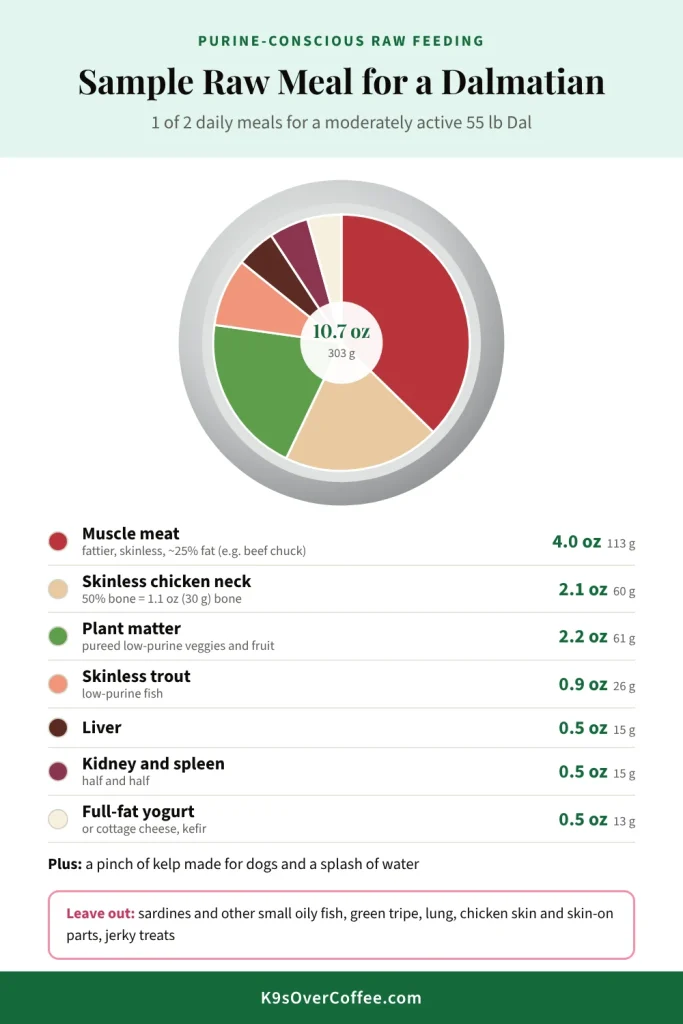
Example: Daily Raw Food for a 55 lb Dalmatian
Here’s what my free raw dog food calculator recommends for a moderately active 55 lb Dalmatian on the purine-conscious plan with 20% plant matter. That’s 21.3 oz (604 g) of raw food per day, about 2.4% of body weight:
- 48% muscle meat (about 25% fat, skinless): 10.1 oz (286 g). The chicken necks below already bring 2.1 oz (60 g) of meat, so you add 8.0 oz (226 g) of muscle meat on top
- 8% low-purine fish (such as skinless trout): 1.8 oz (51 g)
- 10% bone: 2.1 oz (60 g) of bone, which is 4.2 oz (120 g) of skinless chicken necks (50% bone)
- 5% liver: 1.1 oz (31 g)
- 5% kidney and spleen: 1.1 oz (31 g)
- 4% full-fat dairy: 0.9 oz (26 g)
- 20% plant matter: 4.3 oz (122 g)
- Plus a small amount of kelp made for dogs for iodine, and lots of water
Split that into 2 meals a day. Because the meat in this plan is fattier, some Dals need a little less food, so keep an eye on your dog’s waistline and adjust from there.
A Dalmatian Who Eats a Raw Diet: Meet Norman
When I first researched Suzy’s question, I found several raw-fed Dalmatians online. I even got a glimpse into the dinner bowl of Norman the Dal, who lives in the UK and has eaten a raw diet his whole life.
He eats a block of minced chicken in the morning (450 g, just shy of 1 lb), and another block of chicken mix (chicken and bone) at night. His owners add one spoonful of a vegetable, seed and fruit mix to each meal, plus a good amount of water. You’ll notice that his food looks somewhat soupy once mixed together.
The mix they use is from SmartBarf, a UK brand. Ingredient-wise, it’s comparable to dehydrated pre-mixes from The Honest Kitchen, Dr. Harvey’s, Sojos, or Grandma Lucy’s here in the US.


Occasionally, Norman also gets an egg mixed into his food, and every now and then a raw chicken leg. He doesn’t get any red meat, fish or organs because of their purine levels.
What I’d Do Differently for Norman Today
Norman’s owners did a lot right: lots of water, plenty of plant matter and a careful eye on purines. But knowing what I know now, I’d change three things:
- Add the organs back in. Leaving out secreting organs completely creates nutrient gaps that a veggie mix can’t fully close. Liver, kidney and spleen, spread across the week, belong in a Dal’s diet too.
- Add a vitamin D source. Skinless trout or a vitamin D supplement covers what fish would normally bring.
- Check the chicken for skin. Minced chicken often contains skin, which is high in purines. Skinless cuts with some added fat are the better choice.
What Darwin’s Natural Pet Told Me
When Suzy’s question first came in, I also asked Darwin’s Natural Pet for advice, a raw dog food brand I trust and have ordered from for years. Jeanne Romano, a Menu Consultant at Darwin’s since 2009, told me this:
“The answers I give everyone who is nervous about feeding raw (ours or other reputable source) is to talk to their vet first. If they have a holistic vet or pet nutritionist they will be able to create a plan for her two Dalmatians.
Also, if she is planning on making her own raw meals, it is critical she use hormone free, antibiotic free and steroid free, etc… meats. Go to a health food store or the butcher section of stores like Whole Foods or Mother’s to make sure she is getting the “cleanest” meat possible.
In the meantime, if she is worried about purines, I would stay away from any foods (again, ours or others) where there is an over abundance of organ meats such as liver. […] Darwin’s offers duck, chicken and turkey in addition to its red meat selections. However, organs are still part of the poultry package. […] I would definitely research holistic experts to find out exactly what would be safe to feed (cooked or raw) and what to avoid.”

Her point about organs fits what I’d recommend today: not “no organs,” but no excess organs, with the regular 10% made up of liver, kidney and spleen.
Videos of Dalmatians Eating Raw Dog Food
Eindraxsonpax shared a video of their Dalmatian eating raw chicken wings.
ChicagoK9Gal shared a video of her 4 dogs eating a raw chicken leg quarter & chicken gizzards (including 1 Dalmatian).
Dalmata.eu shared a video of Dalmatian puppies eating raw goat milk.
Raw Feeding Dalmatians: Bottom Line
Yes, Dalmatians can eat a raw diet. Most of them do best on a purine-conscious version: fattier, skinless muscle meat, skinless raw meaty bones, liver, kidney and spleen instead of lung and green tripe, low-purine fish like trout, 20-30% plant matter, a little full-fat dairy and kelp for iodine.
Just as important: make sure your Dal drinks plenty of water. If he isn’t big on drinking, simply add more water to his food bowl.
If your Dalmatian has had crystals or stones, work with your vet or a nutrition consultant on a stricter, tailored plan. You can browse the American Holistic Veterinary Medical Association for holistic vets near you. Dr. Coger is one vet who offers consultations and diet formulations, and you can learn more about her services on her website.
Further Reading
For anyone interested in more on raw-fed Dalmatians, I recommend checking out the following links:
- Paisley Dalmatians
- Facebook Group for Raw Fed Dalmatians
Are you the proud owner of a Dalmatian? Do you feed raw or have you considered making the switch? As always, I’d love to hear from you in the comment section below this blog post!
Related Reading
- Raw dog food calculator
- How much fat should be in raw dog food?
- Iodine in raw dog food diets
- Secreting organs for raw dog food
- Can I feed kibble and raw dog food together?
- 24 strong vets who endorse raw feeding

Barbara Rivers is the founder of K9sOverCoffee and a raw feeding educator with over a decade of hands-on experience.
She has fed raw in the US and Europe since 2015, after her Boxer mix Missy’s cancer diagnosis led her to move away from processed kibble and commit to species-appropriate nutrition.
As a former professional dog walker, she developed deep insight into canine behavior, conditioning, and the essential link between proper exercise and long-term health.
Barbara completed online training with veterinarian Dr. Marion Smart and Labrador breeder Dana Scott and works for one of Germany’s leading raw dog food brands, BARFER’S.
In 2026–2027, she is completing a year-long raw nutrition certification for dogs and cats at THP School, founded by raw feeding pioneer Swanie Simon.
Through her blog and weekly newsletter, she provides clear, experience-based guidance to help dog owners feed raw safely and confidently.
I get a lot of my raw by purchasing in bulk with a group of others. One of the ladies who coordinates our orders owns and shows four Dalmatians, all fed a raw diet.
That’s so great to hear! Thank you for sharing that, Rebekah! Do you know if she mainly feeds chicken or turkey?
I have adopted a 4 month old dalmatian and want to learn how to feed him raw food. I read about green tripe but Dalmatian can’t eat red meat, so my question is can I give green tripe to my Dalmatian?
Hi Nalini, thanks for your question – I went ahead and joined the raw feeding Dalmatian Facebook group in order to be able to answer your question. Turns out that yes, Dalmatians can eat green tripe because it’s not a secreting organ (= offal), but muscle meat. I read that you should aim for meats with a purine value of up to 150 for raw-fed Dalmatians. I highly recommend you join that raw feeding Dalmatian Facebook group – it’s full of raw feeding knowledge specific to Dals! Have so much fun with your Dal puppy!
https://www.facebook.com/groups/1456964501241414/
Hi Nalini, I want to update my answer from 2024, because I’ve learned a lot more about feeding Dalmatians since then, including in my BARF nutrition consultant training.
Green tripe is technically muscle meat, not a secreting organ, but it’s still very high in purines. So for most Dalmatians, I’d now leave it out and feed regular muscle meat instead.
The good news: Dals can eat red meat like beef or lamb. What matters most is choosing fattier, skinless cuts with little connective tissue, because purines drop as the fat content goes up.
I’ve updated this post with a full purine-conscious raw feeding plan for Dalmatians, and my free raw dog food calculator now switches on a purine-conscious plan automatically when you select the Dalmatian breed: https://k9sovercoffee.com/raw-dog-food-calculator/?breed=Dalmatian
If your Dal has ever had urate crystals or stones, please work with your vet on a stricter plan. I hope your boy is thriving!
I don’t have a dalmatian, so the dietary changes aren’t relevant, yet. However, I was interested in your take on feeding vegetables and fat (animal fats) to dogs. My dog is mostly keto, although during the humid parts of summer and in the coldest part of winter (here late January or February) I add sweet potatoes, pumpkin puree (usually from cans) or butternut squash if I have some chopped ones in the freezer; I add these because they are draining, that is for animals with trouble managing their water usage, these help with that process to decrease accumulation of excess water in the tissues (called ‘swelling’ by the medical profession).
I was glad to see that the amount of vegetables you add matches mine (~20%). My dog does better with some vegetables in his food bowl, and in some cases, vegetable fiber works better than bones. This doesn’t make sense to me, but it is not my body, so whatever works. To compensate, I use KAL Bone Meal powder to balance the calcium / phosphorus ratio. I have thought about becoming a nutrition coach for raw / fresh feeders who wish to take a more therapeutic approach to their recipes. (on this issue, vegetables are more important than organ meats because of the presence of specific molecules only found in plants, although unless recommended by a vet, would not advise going organ-free).
I am glad to see you pursue further your canine education as your blog posts are well researched and based somewhat upon real life experience with real dogs.
Hi Eileen, thank you so much for this thoughtful comment, and for your kind words! It means a lot coming from a longtime reader.
I love that you adjust your dog’s bowl to the seasons. Sweet potato, pumpkin and butternut squash are some of my favorite additions too. What you describe also reminds me of the food energetics approach from Traditional Chinese Medicine, where some foods are considered draining or drying. I don’t have personal experience with using it that way, but it’s an interesting lens, and your dog is clearly telling you it works for him.
On fat: in a raw diet, fat is the main energy source, so I don’t shy away from it. Most of my dogs’ muscle meat lands around 15-20% fat, depending on how active they are. For Dals, I would go up to about 25%, because purines drop as the fat content of meat goes up. If the meat that’s used for meal prep is too lean, I would add extra animal fat. My free raw feeding fat calculator shows how much: https://k9sovercoffee.com/raw-feeding-fat-calculator/
On vegetables: I’m with you. For most dogs, I feed around 10-20% plant matter. Besides fiber, plants bring compounds you simply can’t get from meat, and some dogs clearly do better with a bit more of them. Fiber and bone also both firm up stools, so it makes sense that veggie fiber can do part of the job bones do for some dogs. Using bone meal instead of raw meaty bones works well, too. Just remember to replace the 10% bone portion with muscle meat and dose the bone meal per the product label, so the calcium and phosphorus stay balanced.
And yes, I agree with you on organs. Unless a vet says otherwise, I’d never leave them out. Even the purine-conscious plan for Dalmatians keeps the full organ portion and only swaps out which organs you feed.
A nutrition coach for raw and fresh feeders who want a more therapeutic approach sounds like a wonderful idea. I think a lot of people are looking for exactly that. Keep me posted if you go for it!
Barbara