
Adding a dog backpack to my pups’ daily workout routine has been one of my best decisions as a doggie mom!
I personally am not a runner, so I honestly don’t know what I would have done without the backpacks when it comes to managing my dogs’ energy.
That applies to my previous Boxer mixes AND to my current Feist mix Wally.
I also frequently recommended a dog pack to my clients back when I ran my own dog walking & pet sitting business.
Many took me up on it and LOVED how much more manageable their dogs were on leash.
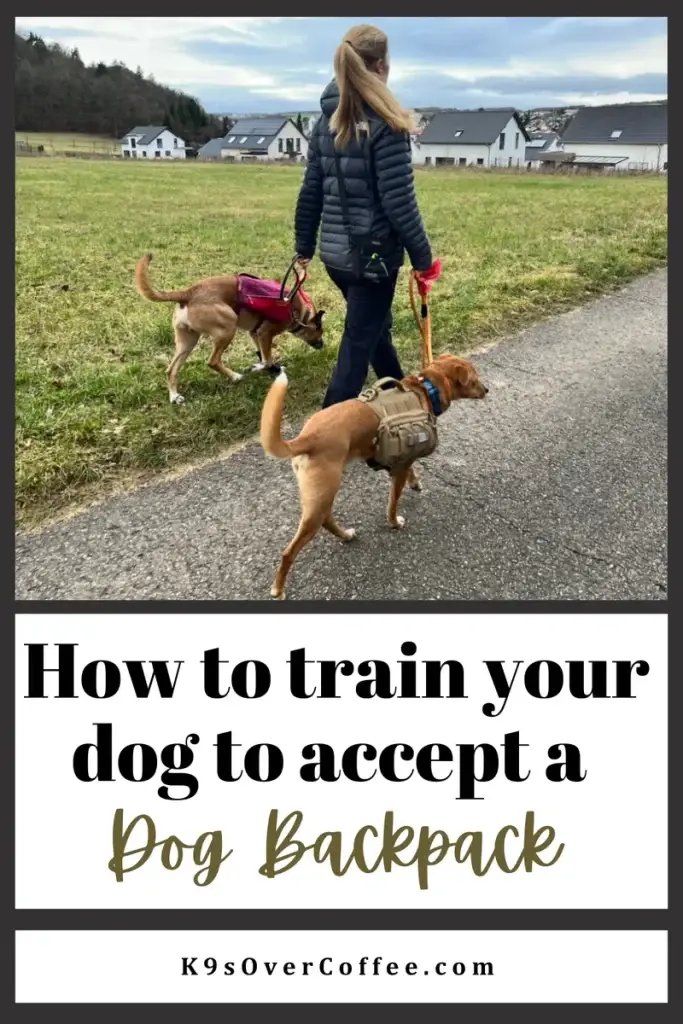
Why Should I Add A Dog Backpack In The First Place?
Very good question! I’m asked all the time why the pups are carrying backpacks. People usually assume that they’re in training for some kind of rescue work.
Well, they’re not.
They’re carrying their backpacks for a combined physical AND mental workout.
Since the pups are Boxer mixes, they’re part of the working dog breed group. They’re active, strong dogs who were originally bred to perform specific tasks/jobs, like guarding properties and doing police work.

Because of that, they’re medium to high energy dogs and need an outlet for their energy. Dog backpacks offer exactly that!
They’re a great way of giving dogs a physical job as well as the mental challenge of focusing on carrying the backpack.
My current pup Wally is a Feist mix. That’s a squirrel hunting dog who has medium to high energy, and he profits from his daily backpack walks just as much as Missy & Buzz did.

That said, the ideal K9 candidate for a dog backpack has medium to high energy and a working background. That includes a variety of dogs, from herding and hunting to retrieving breeds.

Back in my professional dog walking days, I had a client who couldn’t manage their American Pitbull Terrier Doeboy on walks because he pulled like crazy on leash.
I went ahead and introduced him to Missy’s backpack, and guess what – he did great with it and started being much more manageable on walks.
Turns out he just needed a job!

I recommended the same approach for my dog walking client Bailey, and it also worked beautifully for her.

Make Sure Your Pup Is Healthy Before Adding A Dog Backpack
It’s always a good idea to talk to your vet before trying a new physical activity with your pup in order to make sure he’s fit enough for it.
For Missy & Buzz, I started adding doggie backpacks to their walks when they were 8 months old.
I checked with our vet beforehand because I wanted to make sure that I wouldn’t damage their joints by adding too much weight at too young of an age, but the vet said 8 months is just fine.
How To Train Your Dog To Accept a Dog Backpack (Step-By-Step)
Helping your dog feel confident in a backpack is easy when you go slowly and keep everything positive. Here’s a simple training plan that works for puppies, rescue dogs, and strong pullers alike.
Step 1: Let your dog explore the backpack (no pressure)
Set the backpack on the floor and let your dog sniff it at their own pace.
Curious glance? Reward.
One paw step toward it? Reward.
This teaches your dog: “Backpack near me = good things happen.”
Motivation tips:
- Food-driven pups → tiny high-value treats
- Play-driven pups → their favorite ball or tug toy
Step 2: Introduce gentle handling before putting it on
Touch the backpack to your dog’s shoulder, then remove it and reward.
Touch it to their back, reward again.
You’re building comfort with the feeling of the backpack before it ever gets strapped on.
If your dog is wiggly or anxious, keep sessions very short and upbeat.
Step 3: Put the empty backpack on — but don’t fasten it yet
Place the empty backpack over your dog’s back for just a few seconds. Feed a few treats directly on the backpack to build a positive association.
Repeat this until your dog stands calmly while the backpack rests on them.
Step 4: Clip the straps for a few moments
Fasten the straps loosely and reward your dog for standing still.
Don’t go for a walk yet — this step is just about getting used to the feeling of wearing it.
If your dog is unsure, unclip quickly, reward, and try again later.
Step 5: Practice walking indoors without weight
Let your dog walk around the house with the empty pack for a few minutes.
Many dogs forget they’re wearing it after 30–60 seconds.
Use treats, praise, or a toy every few steps so the experience stays fun and relaxed.

Step 6: Take your first real walk with the empty pack
Now head outside for a short walk — just 5–10 minutes.
This helps your dog learn how the backpack moves and shifts during a normal walk.
If they shake, scratch, or freeze, go back a step and slow down. That’s normal.
Step 7: Slowly add weight in tiny increments
Once your dog walks confidently in the empty pack, add just a little weight.
Think:
- 1 small water bottle
- a few toys
- dog poop bags
- human band aids
- some pet first aid items (like Benadryl in case the pups get stung by an insect)
You can increase weight gradually but do not exceed 10–15% of your dog’s body weight (even though manufacturers often say 25%). Slow progression protects joints and keeps the activity fun.

Step 8: Make backpack walks part of your weekly routine
Two or three backpack walks a week can make a huge difference in:
- leash manners
- mental focus
- overall calmness
- energy management
And yes, many dogs start lighting up when they see the pack come out — it’s their “time to work!” signal.
Common Mistakes When Introducing a Dog Backpack
- Adding weight too soon
- Using the backpack on a nervous, under-exercised dog
- Using the wrong size (causes shifting and discomfort – make sure to measure your dog prior to buying a dog backpack as per the seller’s instructions)
- Fast walks or hikes on the first day
- Wearing the pack too long (especially for young dogs)
Video: See the OneTigris Dog Backpack in Action
This is the backpack Wally uses on our daily walks. Here’s what it looks like on him and how it moves when he walks.

Where to Buy Dog Backpacks
Here are the backpacks I’ve used and recommend based on years of experience hiking and walking with my dogs.
That said, I’ve bought my dog backpacks both online on Amazon and in brick & mortar pet retail stores. As far as brands go, I’ve tried a few different ones.
If you’re not quite sure yet if your pup is going to be a good fit for a dog backpack, I’d suggest to go with a less expensive option first.
For example, the Outward Hound DayPak or the OneTigris Dog Backpack.
The Outward Hound DayPak was the first pack I bought for Missy & Buzz back in 2012 for around $30. Although I eventually had to toss it and upgraded the pups to a more expensive and durable dog backpack, it lasted us about a year and half.
I will say that we also used the heck out of it!

DayPak (only 1 color)
Lightweight Starter Pack w/ Handle ✓ Saddlebags for Storage ✓ Breathable Mesh for Comfort ✓ Reflective Accents for Visibility ✓
I bought the OneTigris Mammoth backpack in early 2021 and I still have the same one! So having said that, it is really durable, and I’ve used it a ton with Wally! It retails for around $40.

Mammoth Backpack (5 colors)
Sturdy backpack w/ mesh lining for comfort ✓ Saddlebags for storage ✓ Velcro for patches ✓ Padded handle for assisted lifting ✓
If you’re looking for the same kind of durability with an integrated harness, I recommend Ruffwear’s backpacks.
They’re considerably more expensive, but also last for a very long time – plus, they come in bright colors.
I recommend the Ruffwear Approach Backpack for around $100. I also have the Ruffwear Commuter Pack, but they no longer make that one.
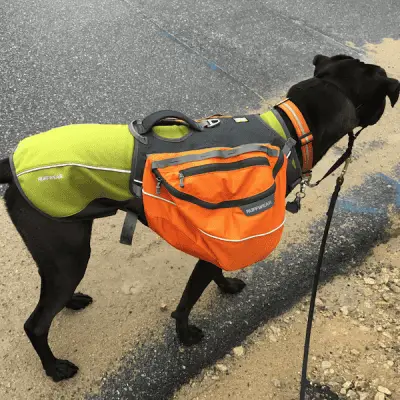
Approach Pack (4 colors)
Spacious saddle bags ✓ Integrated harness ✓ Reflective trim ✓ Padded assistance handle ✓
Frequently Asked Questions About Dog Backpacks
Do Dog Backpacks Help With Anxiety?
Yes — surprisingly often. Many dogs feel calmer when they’re given a “job,” and carrying a backpack provides structured pressure, mental focus, and a purposeful task.
That combination can lower anxiety on walks and help nervous dogs feel more grounded. It won’t replace confidence-building training, but for a lot of pups, it’s a simple tool that makes the world feel a little less overwhelming.
Will a Dog Backpack Help If My Dog Pulls on Walks?
A dog backpack won’t magically fix pulling, but it can make your dog easier to manage. The added weight slows many dogs down and helps them focus on the walk instead of scanning the world for squirrels, smells, or distractions.
It’s not a substitute for loose-leash training, but it’s a genuinely helpful addition for strong, energetic dogs who have trouble settling into a steady pace.
What Backpack Should I Use and How Much Weight Should I Put In It?
Start with a lightweight, well-fitting backpack like the Outward Hound DayPak, OneTigris Mammoth, or Ruffwear Approach Pack — all linked above.
Begin with empty saddlebags, then slowly add weight over several walks. A good starting point is no more than 5–10% of your dog’s body weight, and only work up to 25% if your dog is strong, healthy, and enjoys the activity.
Always distribute weight evenly on both sides.
Dog Backpacks: Bottom Line
A dog pack is a wonderful way of providing your pup with an additional physical as well as mental workout!
Remember to slowly introduce a new dog pack, and to check with your vet before you put one on your young dog.
Now enjoy your backpack walks & hikes!
For more exercise and training resources, visit my full dog lifestyle library.
Related Reading:
- Is The OneTigris Dog Backpack Better Than The Ruffwear Approach Pack?
- Reviewing Ruffwear’s Front Range vs Load Harness: Which One Is Better?
- 8 Dog Slow Feeders to Help Your Raw-Fed Dog Eat Slower
- How To Exercise Your Active Dog When You’re Sick
- 6 Practical Uses For A Tactical Dog Harness

Barbara Rivers is the founder of K9sOverCoffee and a raw feeding educator with over a decade of hands-on experience.
She has fed raw in the US and Europe since 2015, after her Boxer mix Missy’s cancer diagnosis led her to move away from processed kibble and commit to species-appropriate nutrition.
As a former professional dog walker, she developed deep insight into canine behavior, conditioning, and the essential link between proper exercise and long-term health.
Barbara completed online training with veterinarian Dr. Marion Smart and Labrador breeder Dana Scott and works for one of Germany’s leading raw dog food brands, BARFER’S.
In 2026–2027, she is completing a year-long raw nutrition certification for dogs and cats at THP School, founded by raw feeding pioneer Swanie Simon.
Through her blog and weekly newsletter, she provides clear, experience-based guidance to help dog owners feed raw safely and confidently.
Resistance training is important for dogs just like with humans. We also recommend the K9FitVest by DogTread.
-SlimDoggy Steve
Yes! How neat to learn about this weighted vest, I didn’t know they also existed for K9s. Thank you for mentioning it, Steve @SlimDoggy!
We have backpacks we use occasionally. We never needed a slow introduction, just put them on and went. We also don’t have anything really heavy in the pockets as with our long backs we need to be careful.
A backpack definitely doesn’t have to be heavy in order to provide a job ~ a little weight or none at all can be sufficient to provide a mental workout.
People love seeing the packs on the dogs! Everyone thinks it’s so cute and is a great conversation starter. The comments are doubled wherever the dogs are wearing their shoes as well!
Yes, definitely a great conversation starter :-)
Bentley would roll over laughing if I showed him a backpack! I do enjoy seeing dogs carrying their backpacks. They always look so official!
Aww, Bentley..he may give a pack a polite sniff, after all ;-) He is very low to the ground though, so his body style isn’t exactly favorable for a backpack..
We love our doggy packs!
Groundbirdgear.com makes the best packs, you should check them out! They come in 2 parts. We haven’t fitted Ziva for one yet. I think she’s about ready now but really i’m not a fan of young dogs carrying packs as it can be a bit too much during their growth phase – like you said. Ziva had some joint issues as a pup – according to the rescue we got her from, so in the beginning we were careful to not over exercise her and carrying weight was out of the question. We’ve built her up through running, assisted jumps with a harness, glucosamine and rest days. Dante though does great and it helps slow him down! I also like not having to carry things on me. I think they are great in general for any dog that needs extra work during a walk. :-)
Thank you for sharing the Groundbirdgear.com website with us, DZ Dogs, I hadn’t heard of them yet! I like that they custom-make all their harnesses & backpacks!
Very cool to hear that you have a backpack for your boy Dante ~ the pups have carried my keys & wallet, as well as cell phone numerous times..the packs really do come in handy!
I just read your guest post over at mypitbullfriend.com and great job!!
Yay, thank you very much for the kind words :-))
I still haven’t found one small enough for Mr. N. I don’t think they come in his size sadly.
You should check out the following Ruffwear link ~ they have dog backpacks in various sizes, ranging from extra small to extra large!
http://www.ruffwear.com/Approach-Pack-Dog-Pack
Their xxs harness is too big on him and that’s the smallest size they make lol.
Oh no…major bummer! Wow, he really IS tiny, then..maybe the peeps at Groundbirdgear.com can custom-make one for him? DZ Dogs shared their link in a comment on this post ~ I hadn’t heard of them before, but they seem to make quality products!
Hi Y’all!
I have a backpack but when we’re hikin’ off lead in the mountains my Human doesn’t let me where it. She’s afraid I’ll get hung up in something and she won’t be able to get to me.
Y’all come on by,
Hawk aka BrownDog
Hi Hawk ;-)
That makes sense, unless I had a 150% recall on my pups, I also wouldn’t let them roam around unsupervised while wearing a pack.
I’m a big fan of dog backpacks as well. I used one for Ace when I first adopted him and he just needed an additional way to burn up physical and mental energy. I think it also helped him to not pull as much because he was less focused on pulling and a little more focused on carrying his pack. I’d love a pack for my current foster dog. She is tiny and doesn’t fit into Ace’s pack.
Aren’t they just great to burn extra energy?! You are absolutely right, they also help teaching nice leash walking skills ~ so many benefits! Have you checked out Ruffwear? They have packs in various sizes (xxs, xs, s, m, l/xl): http://www.ruffwear.com/Approach-Pack-Dog-Pack.
What great advice! Barley doesn’t like to wear things–when I get her harness out for the car, she hides under the table. When it’s hot, I can sometimes wrestle her into a cooling vest, but I have to pick my battles with her :) So for now, I guess I’ll be the one toting our treats and water. It sounds like a great way to wear out an active dog, though!
Thank you, Beth! Aw, sounds like Barley is the leader of the anti-backpack division ;-) The packs have been a wonderful investment for our pups ~ they are a great way of wearing them out for sure!
Gweat posty and very infurmative. Also gawjus fotos. always luv seein’ happy doggies.
Luv ya’
Dezi and Lexi
Thanks for the compliment, Dezi & Lexi kitties :-)
Great discussion about dog packs. I have heard about groundbird gear before and it looks like they make some really nice packs. On another note, Kona, who passed away a couple of years ago, used to carry his own gear on our hikes. It was great. Except for the couple of times he went exploring and managed to lose his bag in the underbrush.
Thanks, Mark! Groundbird gear has made it onto my list of worthy dog backpack companies to buy from. So far, I had Ruffwear & Cesar Millan’s backpacks on there :-)
Were you able to find Kona’s backpacks?!
Great information and pictures.
Thank you very much!
Great, and informative, post! This will be especially relevant as we start to inch into the warmer months, and more people begin to hike again. You had tons of great advice, and I loved the precautions that you stated. Posts like these help keep our four-legged friends happy and healthy.
Great photos, by the way! Always nice to see other fellow dog lovers out and about!
Thanks for stopping by, Scott, and for your kind words! Yes, we can’t wait for warmer weather & new hiking adventures to come our way :-)
We use a backpack, and it has been so helpful. On our walks people often make jokes that Bain looks like a donkey with his halti and backpack on.
I don’t think some people know really how beneficial it is to add a backpack into their routine. Great post, we use water bottles too!
I think you’re right ~ I’ve rarely come across someone knowledgeable about doggie backpacks! Thanks for the kind words, April!
P.S. If anything, Bain looks like a proud working dog wearing his backpack (& Halti..we use those, too!)
Hi,
I have a 6 months old husky/German Shepherd mix. She’s very high energy, hyperactive but very smart. I am trying to introduce her to wearing a backpack, but she doesn’t let me put it on her, she is not scared of it but she wants to play with it, she tries to steel it, bite it, eat the buckles etc….the only way i would probably be able to put it on would be by force, i haven’t tried this since i am thinking she might keep eating it and try to pull it off even after it is buckled. Can you recommend a smart way to try to put the backpack on?
Background of the puppy: she knows basic commands (sit, stay, come, down) but not 100% obedient i’d say about 70% she obeys the commands unless she is on leash and i force her.
Your help would me much appreciated.
Rita.
Hi Rita, I would introduce the backpack when your pup is in a calm and relaxed state of mind. Let her run off her energy, or take her swimming (I like to take our pups to an indoor doggie pool, you could google it and find out if there’s one nearby you), then gently place the backpack on her, maybe even while she’s lying down.
Also, try placing the backpack on her while giving her a yummy chew if she’s food motivated. She’ll likely be more interested in the chew than playing with her backpack. You should also never allow her to chew on the pack or play with it. When she tries to do that, place the pack out of her reach and offer her a toy she’s allowed to play with.
Luke LOVES his backpack, and I often put it on him for even just shorter walks. I read that it could help give him confidence. I don’t even put a lot in it most of the time. It works as well for me walking him as any harness does too.
So awesome to read that Luke has a backpack :-) I do the same with my pups – they wear them for our morning walks which are typically around 45 mins. The beauty of them is that they intensify the workout of the walk tremendously, so even if we only went for a 20 min walk (which happens when it’s bitter cold outside), it would be the same as walking for 30-40 mins, depending on how much weight the pack contains. And I LOVE that it doesn’t only have the obvious physical benefit, but also the mental one, as you mentioned. It’s definitely a confidence booster and gives them a real job to do!