
Transitioning your dog to raw dog food is one of the most rewarding things you can do for their long-term health – but it’s also the step that trips up most beginners.
Not because raw feeding is complicated, but because the transition from highly processed, high-carbohydrate dry kibble to a fresh, species-appropriate diet asks a lot of your dog’s digestive system all at once.
Done right, most healthy adult dogs transition smoothly within one to two weeks, especially if they have to lose weight. Done too fast – or with the wrong components in the wrong order – you’ll end up with a dog with an upset stomach, a mess to clean up, and a lot of second-guessing yourself.
This post gives you the exact sequence I recommend: what to introduce first, what to hold back until the gut is ready, and why the order matters more than most guides admit.
What this post covers: How to transition a healthy adult dog from kibble to a DIY raw diet – no premix, no hybrid approach. You’ll get the phase-by-phase introduction order, the fat ramp-up rule most guides skip, and a transition example so you can see exactly what the schedule looks like in practice.
If you’d prefer the gentler hybrid route using a dehydrated base mix, I covered that here instead: How I transitioned Wally to raw using The Honest Kitchen.
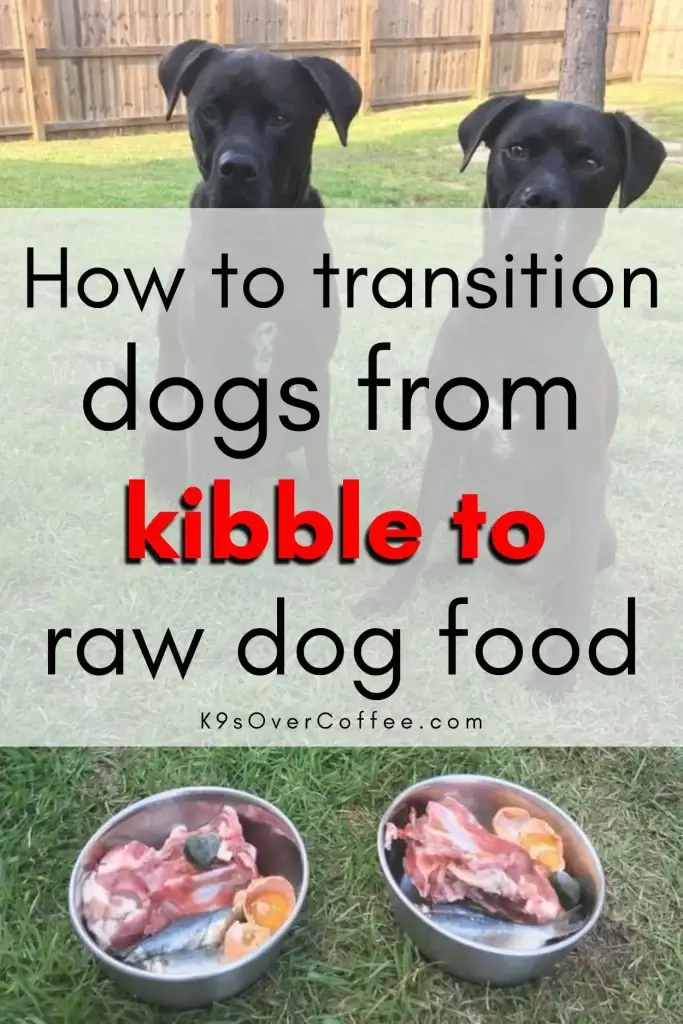
Before You Transition Your Dog to Raw – Calculate How Much to Feed
Before you introduce a single piece of raw meat, you need to know your dog’s daily food amount. Everything in the transition – the phases, the transition example, the component ratios – is a percentage of that number.
For most healthy adult dogs, the starting point is 2% to 3% of ideal body weight per day. A moderately active 40 lb dog, for example, would eat roughly 16 oz of raw food daily. A more sedentary dog might need closer to 2%, while a highly active dog could need 3% or more.
Use your dog’s stool consistency as your real-time guide. Firm, dark stools typically mean the amount is right. Loose stool can indicate too much food, too much fat, or a component that needs more time. Hard, dry stools usually mean that the bone ratio is too high.
Skip the Complicated Math – Use the Free Raw Dog Food Calculator
Get an instant ratio breakdown for muscle meat (including fish), bone, organs, and plant matter based on your dog’s weight and activity level. Works for adult dogs on BARF or PMR, and for puppies from 8 weeks to 12 months.
Try the Free CalculatorShould You Fast Your Dog Before Switching?
A 24-hour fast before the first raw meal gives your dog’s digestive system a clean break – an empty stomach that’s ready to receive something entirely new.
This works well for healthy adult dogs and is worth doing if your dog has been eating kibble their whole life.
Skip the fast if your dog is a puppy, underweight, senior, or managing a chronic health condition. For puppies especially, a short food-free period can cause a drop in blood sugar. Instead, simply transition them from their last kibble meal to their first raw meal at the next scheduled feeding time.
One more thing to know before you start your transition to raw dog food: don’t mix kibble and raw in the same meal during the transition if your dog has a sensitive stomach.
Kibble and raw meat digest at completely different rates – dry food moves through the stomach slowly, while raw moves quickly. Feeding them together can create a fermentation-like environment in the gut that can lead to digestive upset.
Feed the last kibble meal, fast briefly, then start fresh with raw.
The Fat Ramp-Up Rule
This is the single most important thing most transition guides don’t tell you, and it’s the one most likely to cause problems if you skip it.
Dogs that have eaten high-carbohydrate kibble their whole lives have adapted to a low-fat diet. Their bodies produce relatively little lipase – the digestive enzyme responsible for breaking down fat.
When you suddenly introduce a raw diet with a normal or high fat content, the digestive system simply isn’t equipped to handle it yet. The result can range from loose stool and vomiting to, in severe cases, pancreatitis.
The fix is simple: start with lean muscle meat at around 5% fat, and raise the fat content gradually over the following 10 days as the body catches up. Once the transition from kibble to raw dog food is complete and your dog’s digestion is handling everything well, you can move toward whatever fat level your target diet calls for.
In practical terms, this means choosing lean cuts for the first week or two. Ground turkey at 5% fat, chicken breast, and lean beef are all good starting points. Hold off on fattier proteins like duck, lamb, or pork until the transition is complete.
What to Introduce and When
The transition works in four phases, each building on the last. The logic is simple: start with the ingredients that are easiest to digest and most familiar, then layer in the ones that need more digestive adaptation.
The rule throughout is the same at every phase: if a new component causes significant digestive upset, step back to the previous phase for a day or two before moving forward again. Soft stool during the transition is normal. Repeated vomiting or diarrhea is a signal to slow down.
The 4-Phase Transition at a Glance
The transition example uses a 40 lb dog eating 16 oz of raw food per day on a BARF diet.
Muscle meat and plant matter
This is the safest starting point because muscle meat – especially lean cuts like chicken breast or turkey – is the component your dog’s digestive system will find most familiar. Most dogs have eaten some form of animal protein their whole lives, even if it was processed. Plant matter (for BARF feeders) is introduced at the same time and tends to be well tolerated from the start. Oily fish such as sardines or mackerel can also be included from day 1, making up 10% to 15% of the muscle meat portion.
Keep the fat content of your muscle meat low during this phase – around 5% fat. Dogs coming off high-carbohydrate kibble have adapted to producing far less lipase, the enzyme that breaks down fat. Jumping to fatty cuts too quickly can cause digestive upset and, in extreme cases, trigger pancreatitis. You’ll raise the fat gradually over the following 10 days.
Start fish oil at half your dog’s target dose. Kelp and all other mineral and vitamin supplements can be given in full from day 1.
Add green tripe
Green tripe is the unprocessed stomach lining of a grazing animal – beef, lamb, or venison. It’s loaded with naturally occurring digestive enzymes and beneficial bacteria, which makes it one of the best foods you can add during a transition. Start with a small amount and build from there.
If your dog shows any digestive upset after adding tripe – loose stool, vomiting – go back to Phase 1 for another day or two before trying again. The rule throughout this whole transition is the same: if the next component causes a problem, step back, not forward.
Introduce organs – liver first, then a second secreting organ
Liver is the most nutrient-dense component in a raw diet and the one most likely to cause loose stool if you add too much too fast. Start with half the amount your dog will eventually eat at their target ratio, and build up gradually over several days. Once liver is tolerated, add a second secreting organ – kidney or spleen – in the same way: start small and increase.
Don’t rush this phase. Organ meat is where most transition problems happen. A few extra days here saves you a lot of cleanup later.
Add raw meaty bones – start low, build to full allowance by day 10
Raw meaty bones (RMBs) are the most structurally different component – both for your dog’s digestion and mechanically. Start with soft, beginner-friendly bones like chicken necks or chicken wings rather than raw meaty bones with a high bone percentage like heads, and introduce them at about a third of your dog’s eventual full bone allowance. Increase over the following days until you reach the full 10% of daily ration by day 10.
This is also the day you move fish oil to its full dose. Your dog’s gut is now accustomed enough to handle it, and the full Omega-3 support becomes more important as the diet becomes more complete.
Fat in the muscle meat can now begin increasing gradually toward your target level too – there’s no longer a need to keep it artificially lean once the transition is settled.
If your dog can’t tolerate raw meaty bones at all – due to a dental issue, prior injury, or simply refusing them – bone meal powder is a reliable substitute. Swap the entire RMB slot with additional muscle meat and add bone meal on top according to the product’s dosing instructions.
A Note for PMR Feeders
If you’re following a Prey Model Raw (PMR) diet rather than BARF, the transition sequence is exactly the same – just without the plant matter. Your muscle meat percentage starts higher (around 80%) to account for the absence of vegetables, and everything else follows the same order and pacing.
What to Expect During the Transition
Here’s something worth knowing before you start: there is no scientific basis for the “detox reaction” that gets talked about a lot in raw feeding communities.
The idea that symptoms like skin flares, increased shedding, or waxy ears are caused by the body purging toxins is not supported by any research.
What is actually happening is more straightforward – according to a 2017 peer-reviewed study, the gut microbiome, digestive enzymes, and stomach acid levels are all adjusting to a completely different nutritional composition. That adjustment takes time, and it sometimes shows on the outside.
Most transition symptoms are mild and resolve on their own within a few days to a few weeks. If your dog’s general condition is good – alert, drinking water, not in pain – give the process time before worrying.
✓ Normal during transition
- Soft stools or mild loose stool for a few days
- Slightly more gas than usual
- Occasional vomiting (once or twice)
- Coprophagia – poop eating
- Grass eating or signs of mild heartburn
- Drinking less water – raw meat has far higher moisture content than kibble
- Temporary skin flares, increased shedding, or waxy ears – these typically resolve within 2–4 weeks as the body adjusts
⚠ Contact your vet if you see
- Severe or persistent diarrhea lasting more than a few days
- Repeated vomiting – especially if your dog can’t keep water down
- Complete refusal to drink
- Lethargy, weakness, or obvious discomfort
- Symptoms that started during the transition but haven’t improved after 2–4 weeks
- Any symptoms that intensify rather than ease over time
What If My Dog Refuses Raw?
Dogs that have eaten the same processed food their whole life are often genuinely uninterested in raw meat at first. This isn’t pickiness in the human sense – it’s a sensory issue. Kibble is heavily coated in flavor enhancers, palatants, and aroma compounds that raw meat simply doesn’t have. The smell and texture are unfamiliar, and some dogs need time to adjust.
If your dog sniffs the raw meal and walks away, try one of these approaches before giving up:
Sear the meat lightly in a dry pan so the outside browns but the inside stays raw. This is especially useful in the first few days and can be phased out as your dog adjusts.
Scald the meat with a splash of hot water. Less dramatic than searing but enough to release some aroma. Some dogs respond to this immediately.
Add a small amount of a strong-smelling topper – a spoonful of green tripe, a dusting of parmesan, or a bit of dried tripe powder. These are pungent enough to trigger the feeding response in even reluctant eaters.
Mix in a spoonful of canned fish in water – sardines or mackerel – to add a scent the dog finds appealing.
If none of these work after a week of consistent effort, persistent food refusal may have an underlying cause beyond preference – dental pain, nausea, or a gastrointestinal issue worth investigating with your vet.
How to Transition Your Dog to Raw Dog Food: Bottom Line
If you’ve made it all the way down here – yay! You now have a solid grasp of how to switch your dog from kibble to raw without a pre-mix and without the guesswork.
The transition doesn’t have to be overwhelming. Start lean, go slow with organs, hold off on bones until the gut is ready, and let your dog’s stool be your guide. Most healthy adult dogs are eating a complete raw diet within 10 days.
So here’s to ditching the kibble, building real meals from scratch, and watching your dog thrive on food that actually makes sense for their biology – one phase at a time.
For more resources, visit my full raw dog food hub.
Leave your comments or questions in the comment section below!
More Raw Feeding Resources
- Raw dog food calculator
- Weight-loss calculator
- How to safely feed raw meaty bones
- Raw green tripe for dogs
- Liver for dogs
- Secreting organs for raw dog food
- How to feed raw fish for dogs
- Fish oil for dogs
- The benefits of kelp for dogs
- Vegetables in raw dog food
- Dog poop color chart
- Raw dog food hub

Barbara Rivers is the founder of K9sOverCoffee and a raw feeding educator with over a decade of hands-on experience.
She has fed raw in the US and Europe since 2015, after her Boxer mix Missy’s cancer diagnosis led her to move away from processed kibble and commit to species-appropriate nutrition.
As a former professional dog walker, she developed deep insight into canine behavior, conditioning, and the essential link between proper exercise and long-term health.
Barbara completed online training with veterinarian Dr. Marion Smart and Labrador breeder Dana Scott and works for one of Germany’s leading raw dog food brands, BARFER’S.
In 2026–2027, she is completing a year-long raw nutrition certification for dogs and cats at THP School, founded by raw feeding pioneer Swanie Simon.
Through her blog and weekly newsletter, she provides clear, experience-based guidance to help dog owners feed raw safely and confidently.