
Are you aware of the importance of iodine in raw dog food diets?
Because here’s the thing – most raw fed dogs are running short on iodine, and it is not because you are doing anything wrong. About 80% of a prey animal’s iodine is stored in the thyroid gland, and that is exactly the organ every responsible raw feeding guide tells you to leave out.
Once you add in that most commercial raw diets do not include a dedicated iodine source at all, you end up with a nutrient gap that is built right into the model, not a mistake you made along the way.
I run into this a lot from readers who feed 80/10/10 diets (muscle meat, organs, bones). Here is what is actually going on, and two straightforward ways to close the gap.
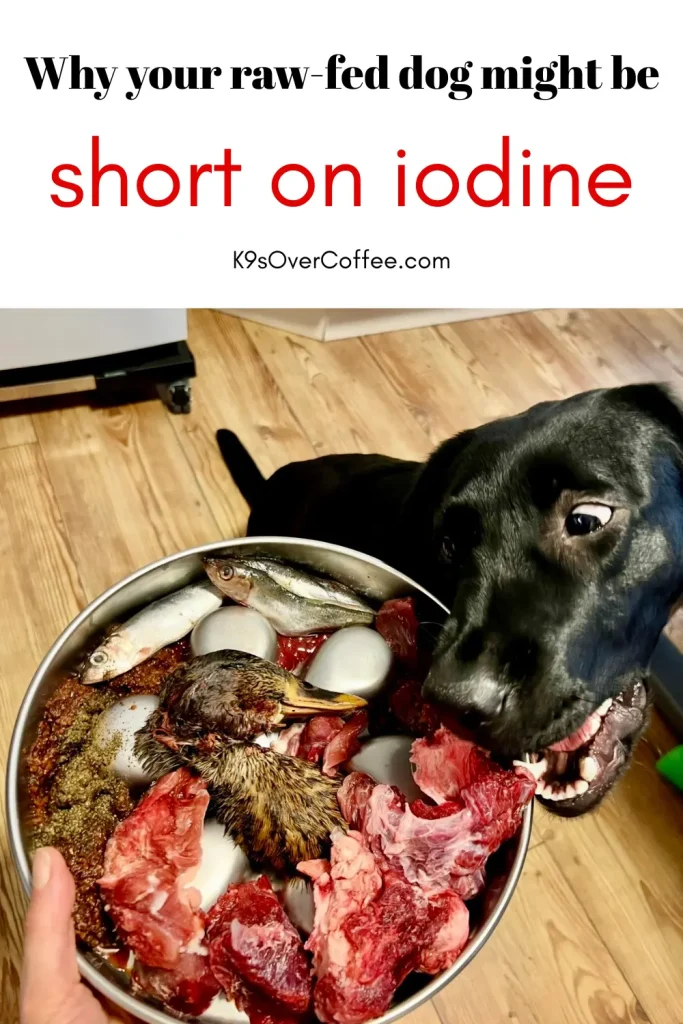
Why Iodine Goes Missing On a Raw Diet
Wild canids cover their iodine needs largely by eating the thyroid tissue of their prey. That tissue concentrates iodine to a degree nothing else in the carcass comes close to.
On a homemade BARF diet, thyroid tissue is deliberately excluded for safety reasons, since it carries active thyroid hormone that can cause real problems if fed in any meaningful amount. That is the right call, but it does mean iodine has to come from somewhere else.
Many commercial raw diets have the same blind spot. If a product is built from meat, organs, and bone alone with no kelp and no added iodine source, the diet will be short on iodine.
One more thing worth flagging: iodine can show up in places you would not expect, like kelp based dental chews or supplements. If you are already supplementing iodine directly, stacking a second hidden source on top can push a dog toward overdosing rather than adequacy, so it is worth checking labels before you add anything new.
Two Ways to Cover the Iodine Gap
1. Kelp. Specifically Ascophyllum nodosum, which is the species that actually delivers meaningful iodine. Spirulina and chlorella get lumped into the same conversation a lot, but neither one provides iodine in any useful amount, so they are not a substitute for kelp.
2. Iodine drops. These make sense when a dog will not eat kelp, or cannot tolerate it. The catch is that almost every iodine drop product on the market is formulated and dosed for human use, and here is the part that trips people up: dogs (and cats!) actually need significantly more iodine relative to their body weight than humans do.
That means the human serving size on the label is not just “not calculated for a dog,” it is very likely too low. If you assume a couple of drops a day is a safe, conservative amount because that is what the bottle says for a person, you are probably under-dosing your dog, especially if they are a larger breed.
The label instructions are not written with a 20 pound dog or a 70 pound dog in mind, so you cannot just follow the bottle. You need to calculate your own dog’s requirement first, then work backward to a drop count.

Raw Paws Organic Sea Kelp
- Ascophyllum nodosum, the iodine-rich species
- Easy to sprinkle over meals
- Supports healthy thyroid function
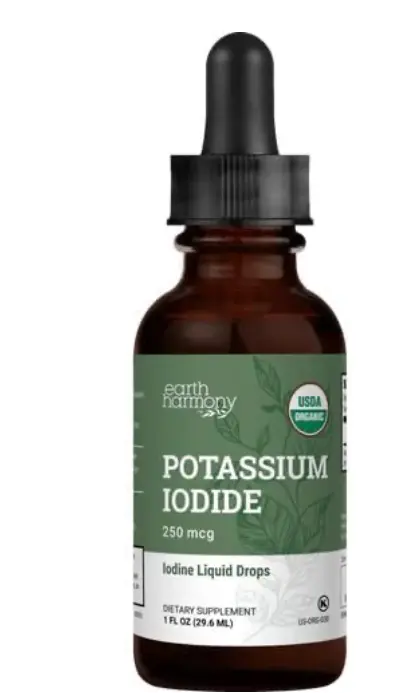
Earth Harmony Potassium Iodide
- USDA organic, 250 mcg per serving
- Easy-dose liquid dropper
- Good option when kelp is not tolerated
How Much Iodine Does Your Dog Actually Need?
This is where metabolic body weight comes in. Smaller dogs have relatively more metabolically active tissue and more surface area for their size, so their iodine need per pound of body weight is actually higher than a large dog’s, not lower. That is why you cannot just scale iodine need in a straight line with body weight.
The formula looks like this:
Daily iodine need (µg) = Factor x body weight in kg^0.75
The reference point I am working from comes from NRC data for a 30 kg dog, whose daily iodine requirement works out to 379.4 µg. Back-calculating from that gives a factor of roughly 29.6 µg per kg^0.75.
I want to be upfront that this factor is a derived estimate from that one reference point, not a number quoted directly as an NRC constant, so treat it as a solid working figure rather than an official published value.
Here is what that looks like for my own two pups:
Wally, at 38 pounds (about 17.2 kg), has a daily iodine requirement of roughly 250 µg.
Pepper, at 60 pounds (about 27.2 kg), has a daily iodine requirement of roughly 353 µg.
Turning that number into an actual drop count
Once you have your dog’s daily requirement, check your specific product’s label for how much iodine is actually in each drop. The potassium iodide drops from Earth Harmony Naturals are a good example: the label states 250 mcg of iodine per 2-drop serving, which works out to 125 mcg per drop.
For Wally, at roughly 250 µg per day: 250 divided by 125 is exactly 2 drops per day, or 14 drops per week. That is about as clean a number as you’ll get.
For Pepper, at roughly 353 µg per day: 353 divided by 125 is 2.8 drops per day, or about 19.75 drops per week. Round that up to 20 drops per week, and since a drop can’t be split evenly across days, spread it as something like 3 drops on three days and 2 drops on the other four.
Here’s the thing worth paying attention to. This particular label suggests taking 2 drops daily as its default use, but that instruction is written for a human adult, not a dog.
It happens to land almost exactly on what Wally needs, purely by coincidence, and it falls short of what Pepper needs because she is a bigger dog.
This is exactly why you cannot follow the bottle as written for your dog under any circumstances: the suggested use was never calculated with a dog in mind at all. Running your own dog’s numbers from their body weight is the only way to know what they actually need.
Your own numbers will differ based on your product’s concentration, so run this same math using the actual label on your bottle rather than the ones above.
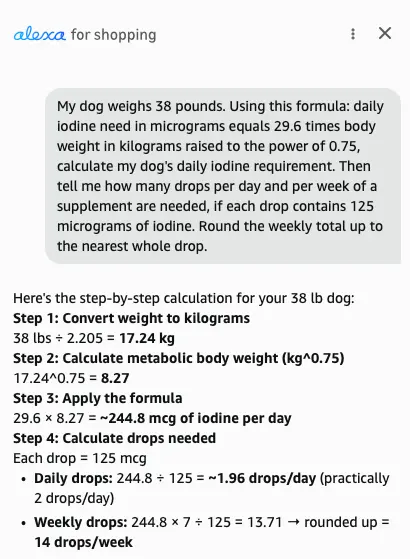
Prompt to ask Alexa (or any other AI assistant):
“My dog weighs [X] pounds. Using this formula: daily iodine need in micrograms equals 29.6 times body weight in kilograms raised to the power of 0.75, calculate my dog’s daily iodine requirement. Then tell me how many drops per day and per week of a supplement are needed, if each drop contains 125 micrograms of iodine. Round the weekly total up to the nearest whole drop.”
Just swap in your dog’s weight in pounds, paste this into Alexa next to the potassium iodide drops from Earth Harmony Naturals on Amazon, and it will walk through the same math I did above for Wally and Pepper.
Safety notes before you start supplementing your dog with iodine
- Do not give the full weekly amount in one sitting. Spread it across at least 3 days to reduce overdosing risk, especially in small and toy breeds where the margin for error is much smaller.
- Weigh or measure small amounts precisely rather than eyeballing drop counts.
- Check for other iodine sources already in your dog’s routine, including kelp based dental products, before adding drops on top.
- If your dog has an existing thyroid condition, this calculation is not enough on its own. The weekly amount should be spread evenly across all 7 days and weighed precisely, and this is a conversation to have with your vet before you start, not something to work out on your own.
Bottom Line
Iodine is one of those nutrients that is easy to overlook because a dog can look and act completely healthy for a long time before a deficiency starts showing up in bloodwork or thyroid function.
The fix is not complicated once you know the math, and once you have calculated your dog’s requirement, it becomes a quick weekly measuring habit rather than something you have to think about every day.
If you have not already read my phytoplankton vs kelp post, that is the natural next stop, especially if kelp is a better fit for your dog than drops. And if you run your own numbers and end up with a drop count that seems off, or your dog has any thyroid history, that is always worth a quick call to your vet before you start.
Related Reading

Barbara Rivers is the founder of K9sOverCoffee and a raw feeding educator with over a decade of hands-on experience.
She has fed raw in the US and Europe since 2015, after her Boxer mix Missy’s cancer diagnosis led her to move away from processed kibble and commit to species-appropriate nutrition.
As a former professional dog walker, she developed deep insight into canine behavior, conditioning, and the essential link between proper exercise and long-term health.
Barbara completed online training with veterinarian Dr. Marion Smart and Labrador breeder Dana Scott and works for one of Germany’s leading raw dog food brands, BARFER’S.
In 2026–2027, she is completing a year-long raw nutrition certification for dogs and cats at THP School, founded by raw feeding pioneer Swanie Simon.
Through her blog and weekly newsletter, she provides clear, experience-based guidance to help dog owners feed raw safely and confidently.
Finally an article about a dog’s real need instead of based upon commercial food, which IMO is insufficient, especially in things like copper, iron or iodine. I do find it interesting that this information is not coming from a veterinarian, but a canine nutritionist who uses it to figure out what to feed and when.
Keep this up. I will bookmark this because I am designing my dog’s food. Iodine, zinc and copper showed up as “out of balance” (whatever that means – I think it involves ratios).I don’t know if you noticed this: I use the NRC guidelines and a recipe that shows up as “balanced” really only balanced in Ca:P ratio. The other ratios, especially those involving Cu appear to be way off. I know in humans, some ratios are more important than others as well, but I am having trouble finding which ones are important and which ones are “less important (a dog won’t get chronically ill)”.