
The real difference between red and white meat in raw feeding comes down to nutrient composition, not quality.
Red meat from ruminants like beef, lamb, goat and venison tends to carry more iron, zinc, and fat, while white meat like chicken, turkey and rabbit brings leaner protein along with a different mix of vitamins and minerals.
Neither one is “better.” The dogs who thrive on raw feeding are usually eating a rotation of both, not picking a side.
If you’ve spent any time in raw feeding groups, you’ve probably run into this debate anyway. Some folks swear their dogs need mostly red meat for iron and energy. Others lean almost entirely on chicken and turkey because it’s affordable and easy to source.
Here’s what separates these two categories, and how to use that knowledge to build a smarter raw feeding rotation.
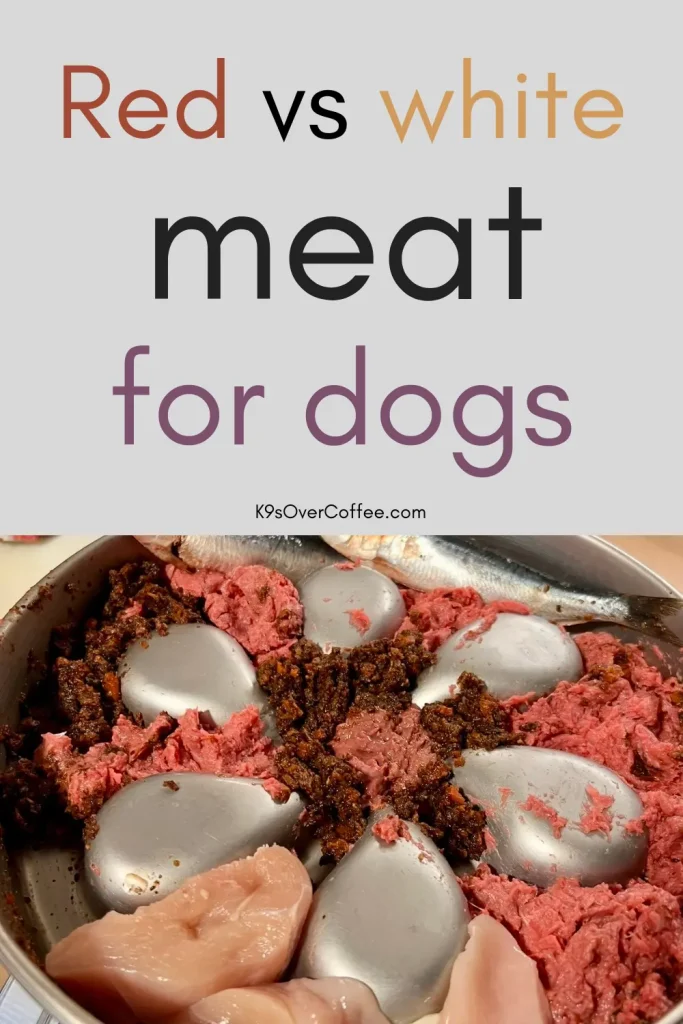
What Counts as “Red” and “White” Meat, Anyway?
In raw feeding terms, red meats are your darker, more myoglobin-rich muscle meats: think beef, lamb, mutton, goat, venison and kangaroo.
White meats are the lighter-colored options: chicken, turkey, duck, rabbit, and fish. It’s a loose grouping (duck, for example, sits somewhere in between), but it’s a useful starting point for thinking about nutrient variety.
Muscle meat of any color is the workhorse of a raw diet. It’s where your dog gets the bulk of their amino acids, plus a solid lineup of minerals (phosphorus, magnesium, iron, potassium, zinc, manganese) along with essential fatty acids and B vitamins.
Protein digestibility from muscle meat runs around 98%, whether it’s beef chuck or chicken thigh, so red vs. white isn’t a digestibility issue. It’s a composition issue.
Fat Content Can Swing Wildly in Red vs White Meat
One of the biggest practical differences between red and white meats is fat. Beef, for instance, can easily run 20% fat or higher depending on the cut, while skinless chicken breast might sit around 2%. Goat tends to land somewhere in the middle, at roughly 10%.
That spread matters because the fat content of muscle meat should average out to somewhere in the 15-25% range across your dog’s weekly rotation. Fat is a dog’s primary energy source in a raw diet, not just a flavor bonus.
If you’re feeding a lot of very lean white meat, you may need to add extra fat elsewhere in the week. If red meat makes up most of the diet, you might not need supplemental fat at all.
Skip the Math – Use the Free Raw Feeding Fat Calculator
Enter your muscle meat amount and the fat % on the label, pick your dog’s target, and get the exact amount of fat to add, automatically rounded to the nearest 5g (or the closest oz equivalent).
Try the Free Fat CalculatorIron, Zinc, and Other Minerals
Red meats generally carry more iron and zinc than white meats and fish, largely because of that higher myoglobin content in darker muscle tissue. Fish tends to bring more vitamin A, vitamin D, sodium, and iodine to the table, along with a meaningfully higher Omega-3 content than land-animal muscle meat, but it often falls short on zinc and iron by comparison.
That’s not a knock against fish. It’s exactly why most raw feeders treat it as a supplement to muscle meat rather than the main event. About 10% of fatty fish (oily varieties are a good source of vitamin D) worked into your dog’s daily raw dog food allowance rounds out what red and white land meats don’t fully cover, without leaning on a single protein for everything.
Zinc is worth a special mention here too: it’s simply better absorbed from animal sources than plant ones, so dogs on a solid raw meat foundation, whether red, white, or a mix, are already ahead on that front.
Taurine: It’s Not Just a “Red vs. White Meat” Thing
Taurine gets a lot of attention in raw feeding circles, and for good reason. It matters for heart health, and certain breeds are more prone to deficiency-related issues. But here’s where the red-vs-white framing actually breaks down: taurine content has less to do with color and more to do with how hard-working the muscle is.
Dark, well-exercised muscle (thighs, hearts, necks) tends to be taurine-rich regardless of species. Turkey thigh meat, for example, is dramatically higher in taurine than turkey breast. The same pattern holds for chicken.
Meanwhile, some lean red cuts of beef test relatively low, while beef heart is quite a bit higher. So instead of thinking “red meat = more taurine,” it’s more accurate to think “working muscle and organ-adjacent cuts = more taurine,” and to make sure some of those cuts show up in the rotation regardless of what species they come from.
One more note: taurine is heat-sensitive and drops noticeably when meat is cooked. It’s yet another reason raw muscle meat has an edge here that cooked commercial diets can struggle to match.
Why Variety Beats Picking a Side
Feeding different animal species is one of the simplest ways to round out a raw diet’s nutrient profile. That’s precisely because red and white meats don’t overlap perfectly on nutrients. A dog eating only chicken is missing out on the iron and zinc density red meat offers. A dog eating only beef may be shortchanged on some of what leaner, lighter meats and fish contribute.
There’s also a practical, forward-looking reason to keep some protein sources in reserve: if your dog ever develops a food sensitivity, having a “novel” protein you haven’t fed regularly (rabbit, venison, or a less common option like kangaroo) gives you a real starting point for an elimination diet.
That’s much harder to pull off if your dog has already eaten everything in the freezer at some point. You don’t need to chase down exotic, imported meats just for the sake of variety. Save those genuinely novel options for if and when you actually need them.
Bottom Line
Red and white meats aren’t competitors. They’re complementary. Red meat have more iron and zinc and often more fat; white meat and fish bring different vitamins, minerals, and generally leaner options; and taurine-rich cuts like thighs, hearts, and necks deserve a spot in the rotation no matter which category they come from.
The dogs who benefit most from raw feeding usually aren’t eating the “best” meat. They’re eating a rotation of proteins that cover far more nutritional ground than any single one could on its own.
If you’re building out a weekly plan, don’t overthink the red-vs-white question. Instead, ask: am I rotating species, balancing fat levels across the week, and including some taurine-rich cuts?
Get those three things right, and the color of the meat becomes far less important than what’s actually on the plate.
Skip the Complicated Math – Use the Free Raw Dog Food Calculator
Get an instant ratio breakdown for muscle meat (including fish), bone, organs, and plant matter based on your dog’s weight and activity level. Works for adult dogs on BARF or PMR, and for puppies from 8 weeks to 12 months.
Try the Free CalculatorRelated Reading
- All about beef raw dog food
- Lamb for raw dog food
- How to make raw dog food with goat
- Kangaroo raw dog food
- Raw chicken for dogs
- Raw turkey for dogs
- Raw duck for dogs
- Rabbit for raw dog food
- How much fat should be in raw dog food?

Barbara Rivers is the founder of K9sOverCoffee and a raw feeding educator with over a decade of hands-on experience.
She has fed raw in the US and Europe since 2015, after her Boxer mix Missy’s cancer diagnosis led her to move away from processed kibble and commit to species-appropriate nutrition.
As a former professional dog walker, she developed deep insight into canine behavior, conditioning, and the essential link between proper exercise and long-term health.
Barbara completed online training with veterinarian Dr. Marion Smart and Labrador breeder Dana Scott and works for one of Germany’s leading raw dog food brands, BARFER’S.
In 2026–2027, she is completing a year-long raw nutrition certification for dogs and cats at THP School, founded by raw feeding pioneer Swanie Simon.
Through her blog and weekly newsletter, she provides clear, experience-based guidance to help dog owners feed raw safely and confidently.
It is important to watch the dog when feeding things like chicken.or venison in the summer (in the northern hemisphere) or duck or pork in the winter. My dog had a ‘reaction’ to duck in the winter. He started shivering as in being cold and ran into a myriad of digestive issues. When spring arrived, he stopped shivering. Why? Duck is energetically cooling, just like venison is energetically warming.
Healthy dogs usually have no issues with eating a cooling protein in the winter or a warming protein in the summer. That is why watching how a dog reacts to the food in the bowl matters as it can tip you off to a simmering issue.