
Are you wondering how to teach your dog down-stay so they’ll stay calm even with distractions around?
In this post, I’ll show you how I’ve taught all my dogs — my Boxer mixes Missy & Buzz, my Feist mix Wally, and now my 6-month-old Labrador puppy Pepper — to master a reliable down-stay using a method called capturing.
It’s simple, positive, and works beautifully once your pup’s energy needs are met.
Pepper learned it fast — thanks to puppy kindergarten, basic obedience classes, and watching Wally demonstrate his own calm stays.
By the way, training is just one part of your dog’s daily routine. For a bigger-picture approach, I’ve put together a full guide on dog lifestyle tips covering routines, enrichment, and everyday care.

Why Down-Stay Matters
The down-stay is one of the most useful commands you can teach your dog.
It teaches impulse control, helps prevent jumping or dashing through doors, and comes in handy during mealtimes, vet visits, or when guests arrive.
But to get there, your dog needs to be both calm and focused — two things that are nearly impossible if they haven’t burned off that morning energy yet!
Step 1: Start With Exercise
A tired dog is a focused dog.
That’s why we always start our mornings with a walk — for my adult dogs, that sometimes includes a dog backpack from OneTigris or a tactical dog harness.
Once we get back home, they have a few minutes of zoomies, and then once the pups settle naturally, that gives me the perfect opportunity to begin the down-stay dog training.

Step 2: Use Capturing To Teach Down-Stay
Capturing means marking and rewarding a behavior your dog offers naturally.
When Pepper (or Wally, Missy & Buzz back in the day) flops down after our walk, I calmly say “down,” add my hand signal (palm facing down), and then calmly praise: “Good job!”
After a few seconds, I give my release cue in a very happy, upbeat tone — “OK!” — so she learns that staying put earns a reward, and release means freedom.
Pro tip: Practice after exercise, not before. You’ll get focus instead of frustration.
Step 3: Build Duration With Patience
Don’t rush. At first, reward your pup after just a few seconds. Gradually increase the duration over several sessions.
Remember: say the command only once. Dogs learn faster when they don’t hear repeated cues.
That’s a lesson I picked up years ago from Patricia McConnell’s book The Other End of the Leash — still one of my top dog training reads.
Step 4: Add Gentle Distractions
Once your dog understands the down-stay, begin to add mild distractions.
Start with something easy like clapping your hands or stepping back.
Then work up to harder ones: opening the fridge or freezer, tossing a toy, or — my personal favorite — placing a bowl of raw dog food in front of them.
Pepper learned surprisingly quickly to ignore the smell of fresh sardines and raw chicken necks, ha!

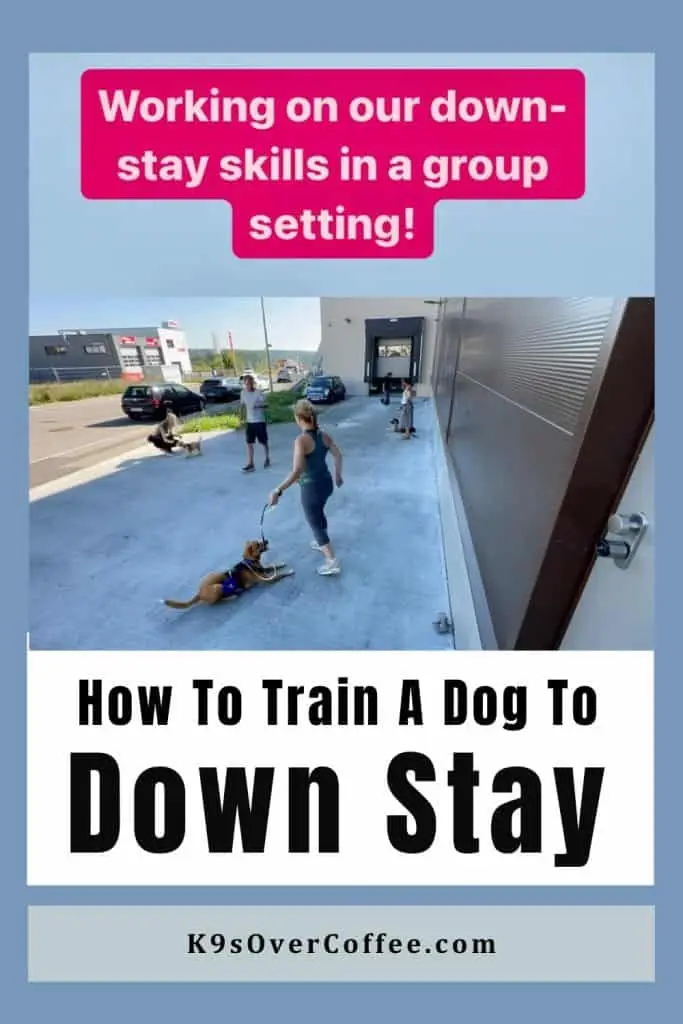
Step 5: Practice Around Other Dogs
Group training classes are gold for proofing commands.
Pepper and I attend weekly puppy classes here in Germany, and it’s incredible practice for real-life distractions.
It also helps me stay consistent with my body language — something I learned with Wally years ago when he was a bit reactive:
- Keep your head high and calm
- Don’t stare down at your dog
- Breathe steadily
- Keep a short, loose leash
Working around other dogs helps your pup understand that “down-stay” means stay even when fun things are happening around them.
Step 6: Reward Smartly
Use what motivates your dog most — food, toys, or affection.
Pepper responds best to small, single-ingredient dog treats, and so does Wally. Missy was the same, but for Buzz, it was squeaky dog toys and his favorite chuck-it ball.
Whatever you use, remember to balance your pup’s daily calories and slowly reduce how often you treat, so your dog listens even without food in sight.
Step 7: Always Release Your Dog
Never forget to release your dog after a stay.
Use one clear release word — “OK,” “free,” or “break” — and stick to it. That clarity helps your pup know exactly when the job’s done.
Step 8: Stay Consistent
Dogs thrive on routine. Practice short, fun sessions multiple times a day.
For example, I’ll ask for a down-stay before setting down meals, opening the door, or greeting friends.
The goal is to weave obedience naturally into your daily life — that’s how solid habits form. Also, make sure that your family and friends are on the same page as you are with your dog’s down-stay training goals.
That way, you avoid sending mixed signals and your pup’s going to learn much faster.
How Much Do Dog Training Classes Cost?
In 2026, dog training costs vary by location:
- Private sessions: about $60 – $120 per hour
- Group classes: $20 – $40 per session
Here in Germany, we pay about €20 per class for our local group training — worth every cent for the focus and socialization Pepper’s gained.
Down-Stay Dog Training: Key Takeaways
- Exercise first
- Capture calm behavior naturally
- Give each command only once
- Reward with what motivates your dog
- Practice around distractions and in class
- Praise and release every time
Training your dog should feel like teamwork — not a power struggle.
And remember: every pup learns at their own pace. Be patient, stay kind, and celebrate every small win along the way.
Related Reading for Teach Your Dog Down-Stay
- How I taught my dog the roll over trick
- How do I train my dog to accept a dog backpack?
- What’s so great about single-ingredient dog treats?
- Sturdy OneTigris mesh dog harnesses: AIRE MESH vs COMET’S TAIL

Barbara Rivers is the founder of K9sOverCoffee. She has been raw feeding her dogs in the US and Europe since 2015, after her Boxer mix Missy’s cancer diagnosis led her to leave processed kibble behind for good.
As a former professional dog walker, she knows firsthand how much nutrition and daily exercise shape a dog’s long-term health.
Today, she works for BARFER’S, one of Germany’s leading raw dog food brands, and is completing a year-long raw nutrition certification for dogs and cats at THP School, founded by raw feeding pioneer Swanie Simon.
Starting in early 2027, she’ll offer one-on-one raw feeding consultations. Join the waitlist.
They’ve got an impressive stay going on. With Laika it took awhile; she would do OK with food but having her “stay” while we worked on nose work games such as hide and seek was a real pain because she’d get so worked up. Eventually with enough consistency and a lot of positive reinforcement when she got it right we managed to get a pretty good stay. Now she’ll even stop immediately for a “down” even if I’ve got a frisbee in my hand and wait for the release. It was one of the more challenging behaviors to teach just because she’d get so antsy. I agree doing a lot of exercises helps tremendously with their focus.
Thanks, Jen! It also took ours longer to keep their “down-stay” when playing hide & seek ~ so awesome that you do that as well with Leika! We’ve found it to be a great pastime when the weather isn’t exactly ideal to go outside. Great job regarding the “down” when a frisbee is involved!
Great article! Love the video too.
Thank you, Talent Hounds!
Marcus sure has pent up energy! He’s like a spring, always leaping and chasing. We’re getting old!
Have you considered adding a backpack for a more intense workout? They really do work wonders ;-)
I wish more people were interested in owning well trained dogs..
I share your wish…