
When I first brought Pepper home at 12 weeks, she was a chunky little Lab pup who needed almost 10% of her body weight in food every single day.
Now that Pepper’s a 4 month old Labrador puppy, things are starting to shift – and today’s post is all about portion adjustments for a growing Labrador puppy.
Because here’s the thing: puppies grow quickly, but their metabolism also changes as they put on size. What worked last month no longer works this month.
But first a quick introduction if you’re new here – hi, I’m Barbara! I’ve been raw feeding since 2015, first my Boxer mixes Missy and Buzz, and now Wally, my 8-year-old Feist mix, and Pepper, our black Lab puppy. These days, I even work for one of Germany’s leading raw dog food brands, BARFER’S.
Today, let’s take a closer look at what’s different for Pepper at four months – from how much raw food she’s eating, to how many meals she’s on, to the new proteins and bones she’s been able to handle now that her adult teeth are coming in.
This post is part 2 of my puppy raw feeding series, where I documented Pepper’s raw feeding journey month by month through her first 12 months with me. If you missed the first one, you can catch up here: Raw Feeding My 3 Month Old Labrador Puppy – Calculating Ratios.
A quick heads-up before you start: the amounts in this post are what Pepper actually ate at 4 months old. I’ve since updated my puppy percentages, and today I’d start a 4 month old Lab at about 4-6% of current body weight. You’ll find the updated numbers in my Labrador puppy feeding chart, or plug your own puppy into my free raw dog food calculator.

Puppy Growth Spurts Mean Portion Adjustments
At three months old, Pepper was eating 9.5 % of her body weight in raw food. Back then, she weighed 26.5 lbs / 12 kg.
At four months, I tapered her down to 9% of her body weight. (Today, I’d start a 4 month old Lab lower, at about 4-6%, and adjust based on body condition.)
That might not sound like a big difference, but for a rapidly growing Lab it’s significant. Too much food can lead to unnecessary strain on developing joints, while too little can leave a pup without the nutrients she needs to thrive.
So I kept up my weekly weigh-ins on our bathroom scale, and at 16 weeks Pepper clocked in at 33 lbs / 15 kg. So in 4 weeks, she put on 6.5 lbs / 3 kg.
Here’s what that looks like in food math:
9% of 33 lbs / 15 kg = 2.97 lbs (47.6 oz) or 1.35 kg (1350 g) of raw food per day
That’s roughly 7.4 oz / 210 g more than she ate last month – simply because she’s bigger now, even though the percentage has gone down.
That’s Pepper’s Percentage – Want Yours?
Every puppy grows at their own pace, so Pepper’s numbers are just one example. Enter your own puppy’s age, weight, and activity level to get an instant, personalized ratio breakdown for muscle meat, bone, organs, and plant matter.
Try the Free CalculatorDaily Meals for a 4 Month Old Labrador
Pepper is still on four meals per day, though she’s starting to tolerate bigger portions much better than she did at three months.
Most Labrador puppies can move down to three meals at around 16 weeks, but for now, splitting her food into four keeps her digestion comfortable and her energy steady throughout the day.
I’ll reassess when she hits the five-month mark.
Pepper’s Current Raw Feeding Amounts
Here’s how her daily 47.6 oz / 1350 g break down across the different raw feeding components:
- 40% muscle meat: 19 oz / 540 g
- 4% heart: 1.9 oz / 54 g
- 4% lung: 1.9 oz / 54 g
- 10% fish: 4.8 oz / 135 g
- 17% raw meaty bones: 8.1 oz / 230 g
- 7% liver: 3.3 oz / 94 g
- 3.5% spleen: 1.7 oz / 47 g
- 3.5% kidney: 1.7 oz / 47 g
- 11% veggies & fruit: 5.2 oz / 148 g
Because her teeth are coming in fast now, she’s been able to graduate to some slightly harder bones – which makes mealtimes more fun for her and helps naturally loosen those puppy teeth.
Want to see what percentage applies to your own puppy?
Example Daily Menu for a 4 Month Old Lab Puppy
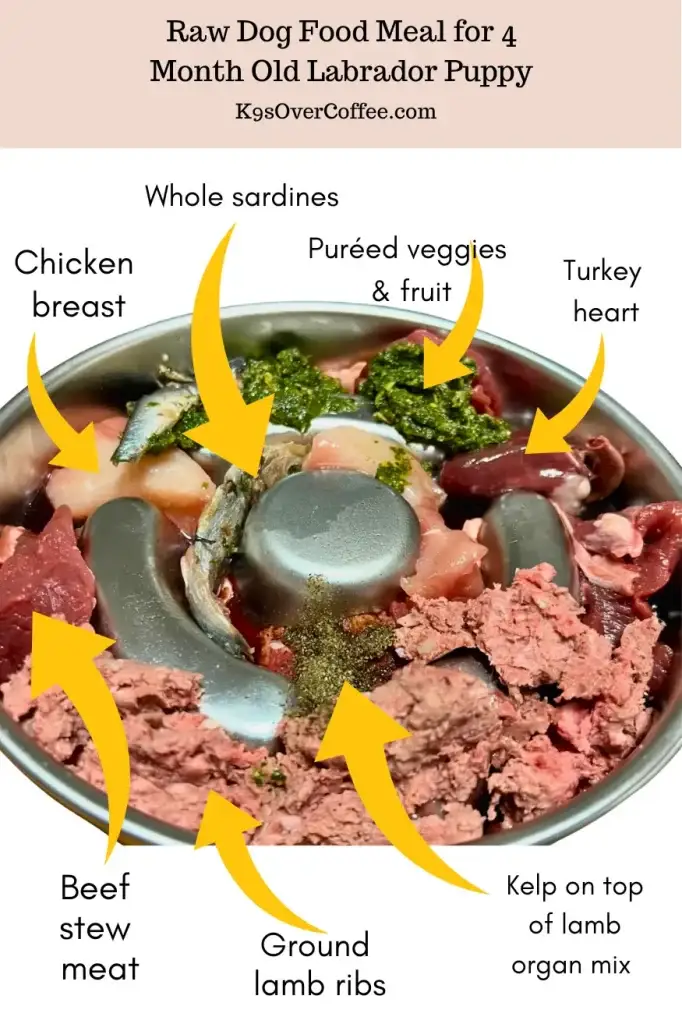
Here’s a real-life example of what Pepper ate on one of her 4-month days using chicken necks as her bone source:
- 9.1 oz / 259 g beef stew meat & chicken breast
- 1.9 oz / 54 g turkey hearts
- 1.9 oz / 54 g lamb lung
- 4.8 oz / 135 g whole sardines
- 18 oz / 511 g chicken necks (includes 9.9 oz / 281 g of meat that goes towards the muscle meat portion)
- 3.3 oz / 94 g lamb liver
- 1.7 oz / 47 g lamb spleen
- 1.7 oz / 47 g lamb kidney
- 5.2 oz / 148 g cooked and pureed veggies (spinach, lettuce, red beets, herbs mix, banana, raspberries)
A quick word on kelp for puppies
For supplements, I still rely on kelp to cover iodine.
That’s because iodine levels in fish and whole prey vary widely, so kelp is the most reliable and consistent source.
By choosing a tested kelp product with a declared iodine concentration, I can safely supplement her diet and support healthy growth without risking deficiency or oversupply.
In the US, I recommend organic kelp from Raw Paws Pet Food. In Germany, I use kelp from BARFER’S, the raw dog food brand I work for.
How to calculate the amount of chicken necks your puppy needs to eat per day
First, you have to know the bone vs meat ratio of chicken necks: 45% bone and 55% meat.
Next, you divide your puppy’s daily bone allowance by the bone percentage of the chicken necks, then you multiply the result with 100.
At 4 months old, Pepper needed 8.1 oz / 230 g of bone every day. So you divide that number by 45 (percentage of bone in chicken necks), and then you multiply it with 100.
In oz, that’s 8.1 oz / 45 x 100 = 18 oz of chicken necks per day.
In g, that’s 230 g / 45 x 100 = 511 g of chicken necks per day.
Remember that the 18 oz / 511 g of chicken necks also have 55% meat. That’s 9.9 oz / 281 g that you can put towards the muscle meat allowance.
Adjusting Percentages Based on Your Puppy’s Body Condition
When Pepper turned 17 weeks old, I actually lowered her feeding percentage again – from 9% down to 8.5% of her body weight.
Why? Because I don’t want her gaining weight too quickly. Growing puppies need plenty of nutrients, but they also need to grow at a steady pace to protect their joints and bones.
This is where it’s so important to remember that every puppy is different. The feeding charts and percentages are a starting point, not a rulebook. What really matters is your puppy’s body condition.
Here’s my simple check:
- Look down at your pup from above.
- You should clearly see a waistline.
- If the waistline has disappeared, your puppy’s carrying too much weight.
In Pepper’s case, dropping to 8.5% kept her looking trim and fit while still giving her the energy she needs for playtime, training, and growing.
Quick tip: If your puppy’s ribs are sticking out too much, increase their daily food allowance by about 0.5% of body weight. If their waistline disappears and they look too chunky, decrease it by about 0.5%.
What’s New in Pepper’s Bowl This Month
This month has been a fun one for experimenting with new proteins and textures:
- Chicken wings – a raw meaty bone with 45% bone, 55% meat
- Duck necks – another new raw meaty bone with 50% bone, 50% meat
- Lamb ribs – first ground then whole, her first “bigger dog” bones at week 18, and she handled them beautifully
- Ground rabbit – leftovers from her big brother Wally’s raw meal prep
- Whole sardines – in addition to herrings, which gave her some variety in oily fish
- Dehydrated furry rabbit ears – fur is a great source of fiber & manganese, and helps clean the digestive tract
- Hemp oil – for some extra plant-based Omega-3s (ALA, so not a true replacement for oily fish) in a dehydrated raw dog food we tested for our upcoming camping trip
She’s also chewing more vigorously thanks to those new adult teeth pushing through – which means RMBs are playing double duty as both nutrition and teething relief.
Life With 4 Month Old Labrador Puppy Pepper: Month Two Highlights
Of course, it hasn’t just been about food this month. Pepper’s been busy soaking up life with us:
- Puppy playtime. Besides her puppy kindergarten classes, we signed her up for puppy playtime. That’s a one hour playtime session per week with her fellow puppy kindergarten students. So fun to watch them race around and play together!
- A night in our tent. We tested the camping waters with her and Wally in our tent in the backyard on a Saturday night. She did amazing sleeping in the tent – no barking, just lots of cozy snuggles and one 4 am potty break.
- Meeting more people and dogs. Socialization is still top of the list, and I’m stoked at how friendly and curious she is with new experiences, especially at my dog-friendly work, where she’s also modeled in front of the camera.
- Graduating puppy kindergarten. After 4 sessions at puppy kindergarten, she’s ready to level up and start dog training with slightly older pups. We had a total of 7 sessions, but missed a few. So we can move those to the next dog training level – which I love how flexible the dog trainers are!
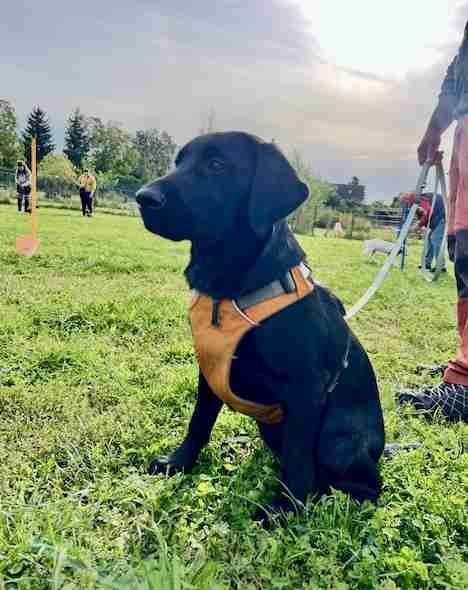
Of course, she’s also perfected the art of carrying around anything she can fit in her mouth – shoes, socks, branches, you name it.
One bad habit we need to break her off is picking up and carrying little rocks around that she finds in the yard, because she then starts chewing on them.
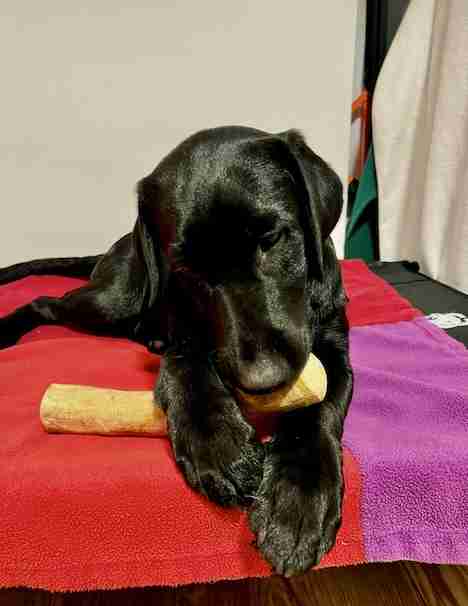
That’s really bad for her teeth, so we bought her olive wood chewing sticks and a coffee wood dog chew as a healthy alternative.
So far, she’s liking the trade – paws crossed that she won’t get bored of them too quickly.
Update at 7 months of age – Pepper still loves her olive wood sticks! (We lost the coffee wood kind on our camping trip).
Final Thoughts
Raising a raw-fed Labrador puppy is equal parts food math, messy mealtimes, and soaking up all these little milestones. Watching Pepper thrive on fresh food is the best reminder of why I started raw feeding in the first place.
Want to see how she grew from here? Head over to raw feeding my 5 month old Labrador puppy, or follow her all the way to her first birthday in my Labrador puppy raw feeding series.
Related Reading:
- Raw feeding my Labrador puppy month by month
- Raw dog food for puppies: how much and what?
- Raw dog food meal prep for beginners
- Easy raw dog food feeding charts and worksheets
- 10 easy ways to puppy-proof your home
- How to teach your puppy to walk on a leash

Barbara Rivers is the founder of K9sOverCoffee. She has been raw feeding her dogs in the US and Europe since 2015, after her Boxer mix Missy’s cancer diagnosis led her to leave processed kibble behind for good.
As a former professional dog walker, she knows firsthand how much nutrition and daily exercise shape a dog’s long-term health.
Today, she works for BARFER’S, one of Germany’s leading raw dog food brands, and is completing a year-long raw nutrition certification for dogs and cats at THP School, founded by raw feeding pioneer Swanie Simon.
Starting in early 2027, she’ll offer one-on-one raw feeding consultations. Join the waitlist.