
Eight months in – and Pepper is very clearly no longer a tiny puppy, but also not quite an adult yet.
We’re firmly in that teenage Labrador phase where her body seems to change every other week, her confidence keeps growing, and there are even signs that she may have already gone through a very mild first heat.
That shift toward maturity is also reflected in how much she’s eating.
As an 8 month old Labrador puppy, Pepper is eating 5% of her body weight in raw dog food per day.
That means she’s still eating more than an adult Lab would – but her growth has slowed enough that we’re tapering her daily percentage down month by month toward eventual adult maintenance of about 2-2.5%.
This post is part 6 of my puppy raw feeding series, where I documented Pepper’s raw feeding journey month by month through her first 12 months with me. If you missed the previous one, you can catch up here: Raw Feeding My 7 Month Old Labrador Puppy – Meals, Mischief & Milestones.
A quick heads-up before you start: the amounts in this post are what Pepper actually ate at 8 months old. I’ve since updated my puppy percentages, and today I’d start an 8 month old Lab at about 2.7-3.7% of current body weight. You’ll find the updated numbers in my Labrador puppy feeding chart, or plug your own puppy into my free raw dog food calculator.
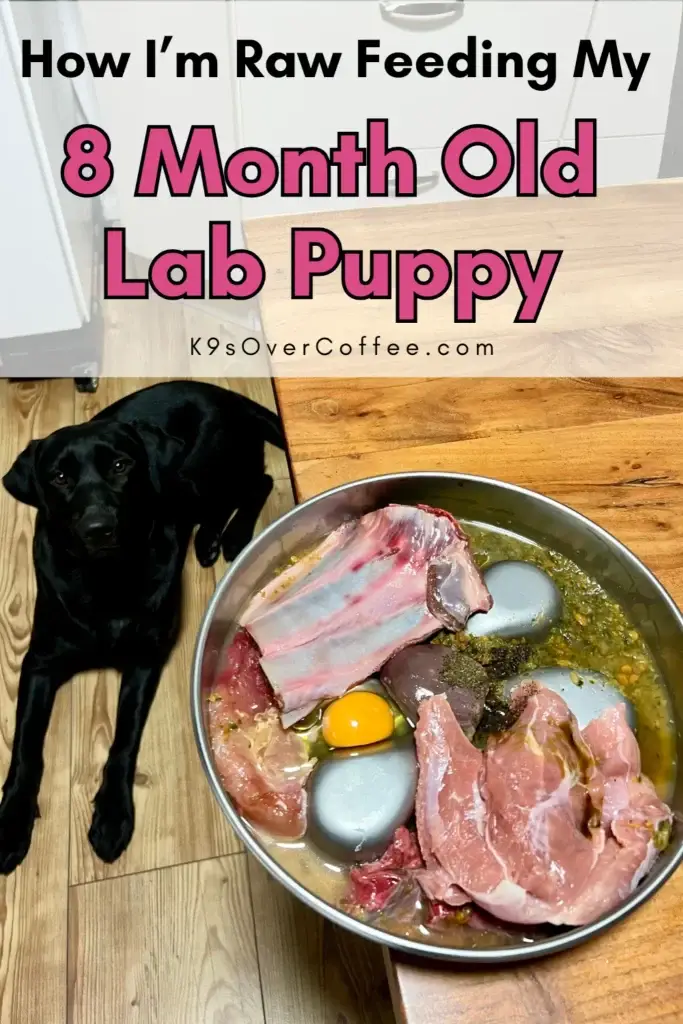
Pepper’s Weight & Daily Food Amount at 8 Months
Pepper now weighs 24.5 kg (about 54.0 lbs).
At this stage, I’m feeding her 5% of her body weight, which puts her daily raw food intake at:
1,200 g per day (about 2.65 lbs / 42.3 oz)
Her growth rate continues to slow and she’s laying down muscle instead of puppy fluff – exactly what I want to see in a young Labrador.
Get your puppy’s exact percentage in seconds!
Daily Raw Feeding Ratios for My 8 Month Old Lab Puppy
Here’s how her 1,200 g (2.65 lbs / 42.3 oz) daily portion breaks down:
- 40% muscle meat:
480 g (16.9 oz) - 8% heart:
96 g (3.4 oz) - 7% liver:
84 g (3.0 oz) - 3.5% kidney:
42 g (1.5 oz) - 3.5% spleen:
42 g (1.5 oz) - 17% (raw meaty) bone:
204 g (7.2 oz) - 10% fish:
120 g (4.2 oz) - 11% veggies & fruit:
132 g (4.7 oz)
These ratios continue to support steady growth, strong bones, great digestion, and that glossy black Lab coat we love touching.
That’s Pepper’s Percentage – Want Yours?
Every puppy grows at their own pace, so Pepper’s numbers are just one example. Enter your own puppy’s age, weight, and activity level to get an instant, personalized ratio breakdown for muscle meat, bone, organs, and plant matter.
Try the Free CalculatorRaw meaty bone needs explained
I’ve shared raw meaty bone math before on the blog, so here’s just a quick reminder of how I figure out how much raw meaty bone I need to feed Pepper.
When I say that Pepper needs to eat 17% raw meaty bone, it means that she requires 17% of bone on a daily basis, which is found on raw meaty bones.
It’s important to understand though that raw meaty bones don’t just have bone, but that there’s also meat attached to them.
The exact ratio of bone: meat depends on the raw meaty bone.
For example, raw turkey necks have 40% bone and 60% meat, while raw venison ribs have 45% bone and 55% meat.
And chicken heads have 75% bone and 25% meat.
That said, here’s how to calculate how much raw meaty bone your Labrador puppy needs per day: Divide their daily bone allowance by the bone percentage of the raw meaty bone, then multiply with 100.
Keep reading to see how I did the math for some of Pepper’s meals using venison ribs as the raw meaty bone.
Sample Raw Meal for My 8 Month Old Labrador Puppy
Here’s a real-life example of one of Pepper’s meals, using venison ribs as the main bone source. Like I said earlier, venison ribs have 45% bone and 55% meat.

The full recipe (1 meal, half of her daily amount):
- Chicken breast:
116 g (4.1 oz)
(Technically 240 g / 8.5 oz total muscle meat – but the venison ribs contribute about 124 g / 4.4 oz of attached meat, which I count toward her muscle meat allowance) - Turkey heart:
48 g (1.7 oz) - Rabbit liver:
42 g (1.5 oz) - Rabbit kidney:
21 g (0.7 oz) - Rabbit spleen:
21 g (0.7 oz) - Venison ribs:
226 g (8.0 oz total)
(Venison ribs are roughly 45% bone / 55% meat – about 102 g / 3.6 oz bone and 124 g / 4.4 oz meat) - Mackerel (fish):
60 g (2.1 oz) - Veggies & fruit (cucumber, lettuce & apple):
66 g (2.3 oz) - Kelp:
Use a kelp made for dogs and follow the dosage on its packaging, as it varies depending on the kelp origins
This kind of breakdown is a great example of why raw feeding isn’t just about throwing ingredients into a bowl – it’s about understanding what’s attached to your bones and adjusting the rest of the meal accordingly.
Feeding Schedule: Two Meals a Day
Pepper is now fully on two meals per day, and she’s doing fantastic on it.
No hunger pukes, no energy dips, consistent appetite and perfect poops.
And just as importantly – Wally has adjusted beautifully too.
When Pepper was eating four meals (and later three), I always split Wally’s daily raw food allowance into the same number of meals so he wouldn’t feel left out.
First Heat in Female Labradors: What I’m Watching for With Pepper
As Pepper reached 8 months old, I began noticing a few subtle signs that made me wonder whether her first heat had already happened.
Over a short period of time, I noticed a few subtle changes:
- Increased licking
- A few light brownish spots on a pale blanket, which may have been blood
- Wally showing noticeably more interest in her vulva and sniffed her more than usual
What I didn’t notice was obvious bleeding on the floor or dramatic swelling – and that seems to be very common during a dog’s first heat.
When do female Labradors usually go into heat?
Most female Labradors experience their first heat between 6 and 12 months of age, though anywhere from about 5 to 15 months can still be normal, especially in larger breeds.
First cycles are often:
- lighter
- shorter
- and easier to miss
Some females keep themselves so clean that you’ll only ever notice spotting on light fabrics – or not at all.
What to expect during heat in Labrador puppies
A full heat cycle typically lasts around 2-4 weeks. During that time, it’s normal to see:
- Increased licking
- Minor behavior changes
- Fluctuations in appetite or energy
- Increased attention from male dogs
Even a very mild first cycle still counts.
Whether that short phase was Pepper’s first heat or not, nothing about it was concerning. I’ll keep an eye on future patterns, since cycles often become more obvious and regular over time.
Life at 8 Months: Holidays, New Experiences & Growing Up
Aside from her meals, Pepper’s 8-month milestone was filled with a lot of new experiences.
She spent Christmas and New Year’s at my parents’ house and experienced her first live Christmas tree indoors – which she handled beautifully. No chewing, no stealing ornaments, no general chaos.
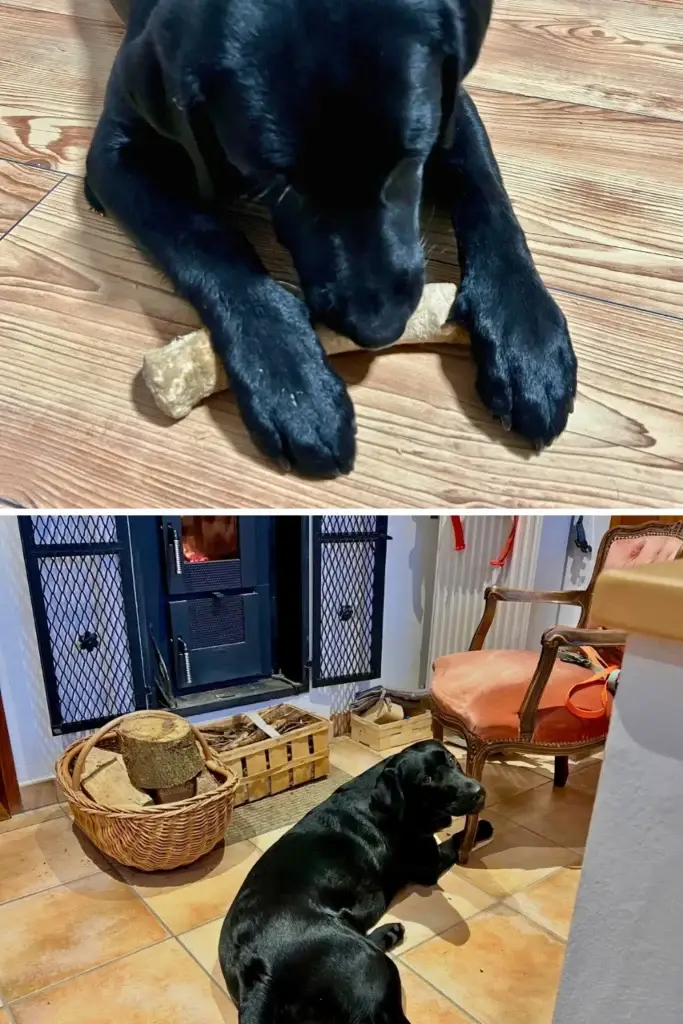
The only small hiccup came from my parents’ firewood basket.
Pepper clearly didn’t distinguish between her olive wood dog chew (which she’s allowed to chew) and the firewood meant for the fireplace. Honestly, that one’s on us – wood is wood in puppy logic.
With a bit of consistency, she quickly learned that:
- wood inside the basket is off-limits
- her olive wood chew outside the basket is fair game
It was a good reminder that at this age, she’s still learning how the world works – even though she looks much more grown up already.
Between holiday travel, busy houses, new routines, and all the physical changes happening right now, Pepper handled this month with a lot of confidence.
She’s clearly settling into her role as a young dog rather than a tiny puppy, and it continues to be really nice to watch that transition happen in real time.
How She’s Doing Overall at 8 Months
A few observations from this stage:
- Her coat remains thick, shiny, and jet black.
- She’s confident in new environments and handled the busy holiday household beautifully.
- Her appetite is steady and predictable, which makes raw feeding adjustments much easier.
Teenage moments still happen (of course), but overall, she’s turning into an incredibly well-balanced young dog.
Final Thoughts
Eight months feels like a quiet turning point.
Pepper is still playful and goofy, but there’s a noticeable shift toward maturity – in her body, her routine, and even her ability to settle. Her raw meals continue to support her exactly how I want them to: strong bones, excellent digestion, and steady, controlled growth.
Next month, I’ll share how her portions continue to evolve as she moves closer to adulthood, and further percentage tweaks along the way.
Want to see how she grew from here? Head over to raw feeding my 9 month old Labrador puppy, or follow her all the way to her first birthday in my Labrador puppy raw feeding series.
Related Reading
- Labrador puppy raw feeding series
- Olive wood dog chews for puppies
- How to measure percentages in raw feeding
- Raw dog food for puppies – how much and what
- Easy raw dog food feeding charts and work sheets (adults and puppies)

Barbara Rivers is the founder of K9sOverCoffee. She has been raw feeding her dogs in the US and Europe since 2015, after her Boxer mix Missy’s cancer diagnosis led her to leave processed kibble behind for good.
As a former professional dog walker, she knows firsthand how much nutrition and daily exercise shape a dog’s long-term health.
Today, she works for BARFER’S, one of Germany’s leading raw dog food brands, and is completing a year-long raw nutrition certification for dogs and cats at THP School, founded by raw feeding pioneer Swanie Simon.
Starting in early 2027, she’ll offer one-on-one raw feeding consultations. Join the waitlist.
Pepper looks fantastic! You’re doing very well with her.
Thanks, Anneliese, it’s rewarding watching her grow up and thrive on raw dog food!